
Striking it rich has been the goal of prospectors for centuries, and nowadays, local gold enthusiasts still like to try their best at finding treasure.
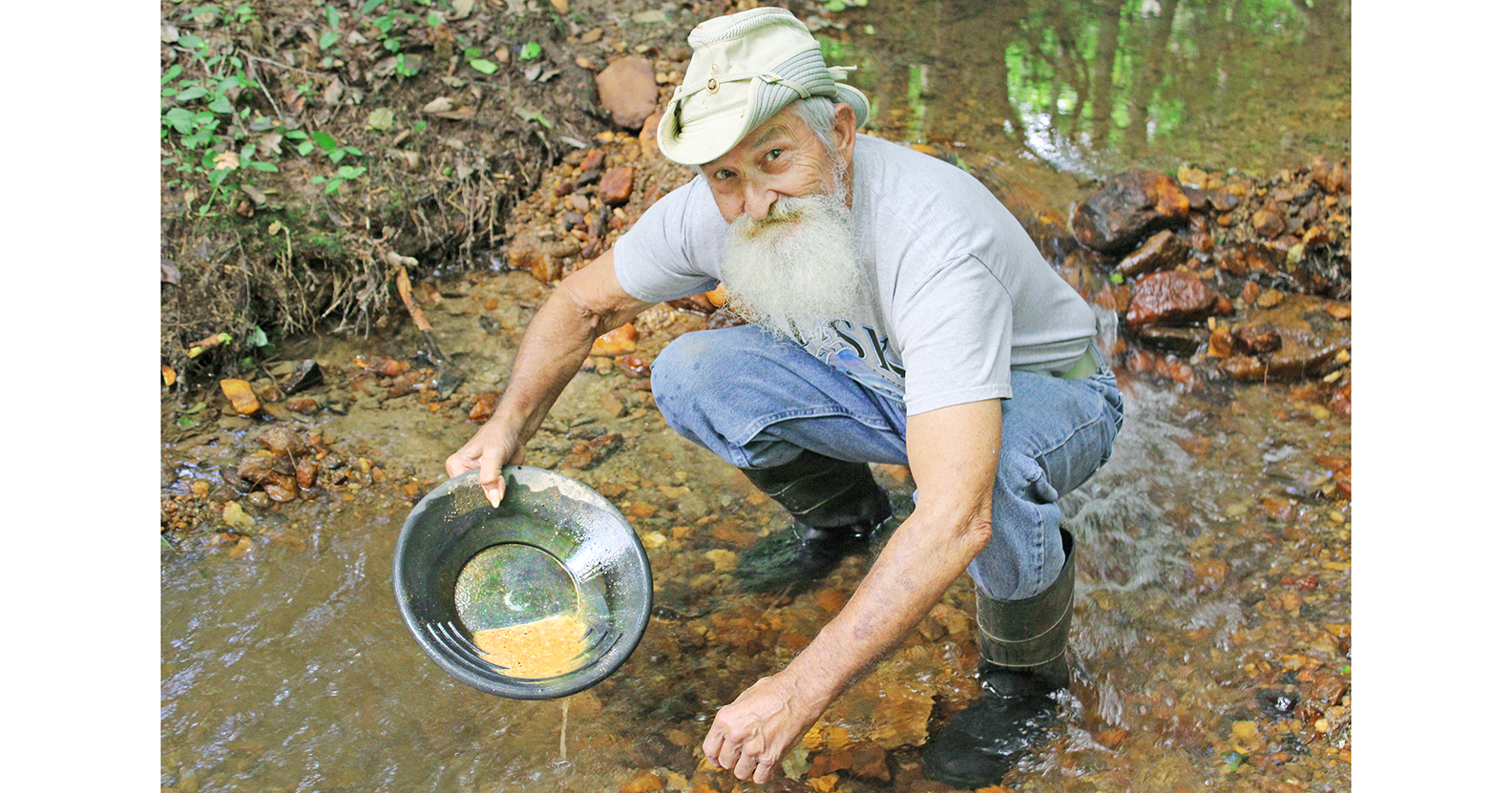
Dahlonega resident Sam Kwiecien has the hard-worn, grizzled appearance befitting an expert gold miner, but that dovetails perfectly with his favorite hobby.
The 73-year-old Navy veteran and part-time volunteer at the Dahlonega Gold Museum falls into a sub-category of amateur prospectors known as backyard miners, or simply “backyarders.”
These hobbyists make use of simple equipment and do-it-yourself ingenuity to access potential gold deposits on their own property.
Kwiecien, who lives off of Cavender Creek Road, uses a mix of equipment purchased from nearby Crisson Gold Mine.
PROSPECTOR’S PARADISE
Kwiecien first dabbled in gold panning while stationed at Miramar Naval Base in California.
A friend living in San Bernardino took Kwiecien up to the Tacoma Pass, where he said panned for gold using “ a Volkswagen hub cap.”
But Kwiecen would get his first true taste of “gold fever” while visiting Dahlonega.
“I came up to Crisson’s Mine here and started panning with their dirt and learning the techniques. Tony [Ray], the owner, was instrumental in helping me refine my techniques. He showed me basically how [to pan], and I guess I got better as I went,” Kwiecien said.
Before he and his wife officially moved to their property in 2017, Kwiecien would set up a makeshift camp there and dredge for gold.
“My wife wouldn’t come with me unless she had something that closed and something that flushed, so I built her a house,” he joked.
OLD-TIME OPERATION
Kwiecien’s property is located only four-tenths of a mile from the old Garnet Gold Mine.
In addition to several mining artifacts found there, he has also discovered two significant rock deposits near the creek on his land, which he speculates were part of the exhaust dump from a former operation.
“I have three tiers of cascading, uniform-sized rock that you would expect to come down a sluice. And going up the property, there is a wedge-shaped washout where you would expect water was coming over or leaking through the boards of a wood-board sluice,” Kwiecien explained.
In addition, he said the flat piece of land where his work shed currently sits was once covered with blaster pits, evidence that explosive charges were used to extract minerals close to the surface.
Finally, Kwiecien has noticed upright, jagged rocks in the creek that could further indicate artificial strata upheaval from mining.
“That white rock on that granite, that’s quartz rock,” he said, gesturing towards the creek bed. “That’s what they look for in stamp mills to crush and get the gold out of.”
IMPROVISED TECHNIQUES
The main piece of equipment Kwiecien uses to obtain suitable panning dirt is a three-inch, gas-powered dredge that he purchased from Crisson.
“The water comes up through an intake hose, goes into a smaller hose, that goes into a larger hose and at that point it becomes a vacuum and starts sucking dirt and water up. As the dirt comes through the feed hose, it goes over the sluice,” he explained.
Any gold settles into the metal ripples in the sluice and falls onto a layer of green, woven vinyl material called miner’s moss that will filter out larger nuggets of gold, while the finer material gets trapped in a bottom layer of carpet.
Afterwards, the moss and carpet layers can be carefully removed from the sluice and rinsed off into a large bucket. That dirt can then be panned down to find any gold.
Normally the dredge floats in the middle of the creek on built-in pontoons, but Kwiecien operates his machine on the bank beside the water due to periodic flooding that could ruin the equipment.
Kwiecien operates the dredge roughly twice a week, for an hour or so each time.
ALTERNATE EQUIPMENT
In addition to the classic dredge and pan combination, Kwiecien has collected a mix of other mining equipment, including a hose-powered device called a trommel.
“You shovel dirt into that pan. There are water jets that push it down into this cage. The gold goes through the sluice and onto the miner’s moss and then exhausts from there,” he explained.
The main difference between a trommel and a dredge is that the material has to be manually loaded into the machine for processing. The key advantage is increased portability.
“The legs fold up. It can be carried or wheeled wherever you want to work,” Kwiecien said of the trommel, which was custom made for him by an employee at Crisson.
PANNING PRO
Kwiecien said the biggest fear of the amateur panner is losing your gold.
“You probably will,” he acknowledged. “But once you have about a tablespoon full, you take it and just gently curl it in one direction, give it a good pat, and that will seat all the gold to the very bottom … if there is any gold it will sit there and stay still,” he added, noting that gold is “19 times heavier than the same amount of water.”
The final step is cleaning your gold, and for that critical step, Kwiecien offered an insider tip.
“People try to use dishwashing soap, and it will work, but it causes bubbles and the float gold, the very fine gold, will float on those bubbles and when you pan it, it will float away,” he said.
Kweicien recommends Finish Jet Dry rinse aid instead.
“Just a little drop. If there was any float gold in that, that would break the surface tension and drop the float gold down. Then you take the pipette and just try to blow some of that black dirt away from it, and then squeeze it out, find your target, and suck it up,” he concluded.
THE RIGHT TOOLS
Tammy Ray, co-owner of Crisson Gold Mine, said backyard mining and prospecting has always been a big component of her business.
“I am the largest stocking dealer in the southeast of mining equipment. And I have anything from a bottle to put your gold into a gold pan to a sluice box to a dredge. I go up to a four inch dredge, and carry all kinds of parts and pieces,” Ray said.
Ray said she has been educating people about gold prospecting in Dahlonega since 1986, and knows the importance of matching miners with the right tools for the job.
“That’s the thing: if they’re not finding gold, they’re not going to want this equipment. So I want to make sure they get the correct equipment that they need for the application,” Ray said.
The new Fall edition of The Mountain Traveler is available at area chambers of commerce, visitors’ centers, and many locations around the Northeast Georgia region.
To read the Fall 2025 edition of The Mountain Traveler online, click here:
https://etypeproductionstorage1.blob.core.windows.net/$web/Production_Prod/Jobs/238/2025-09-26/485132/FlippingBook/Northeast-Georgian_485132/index.html