
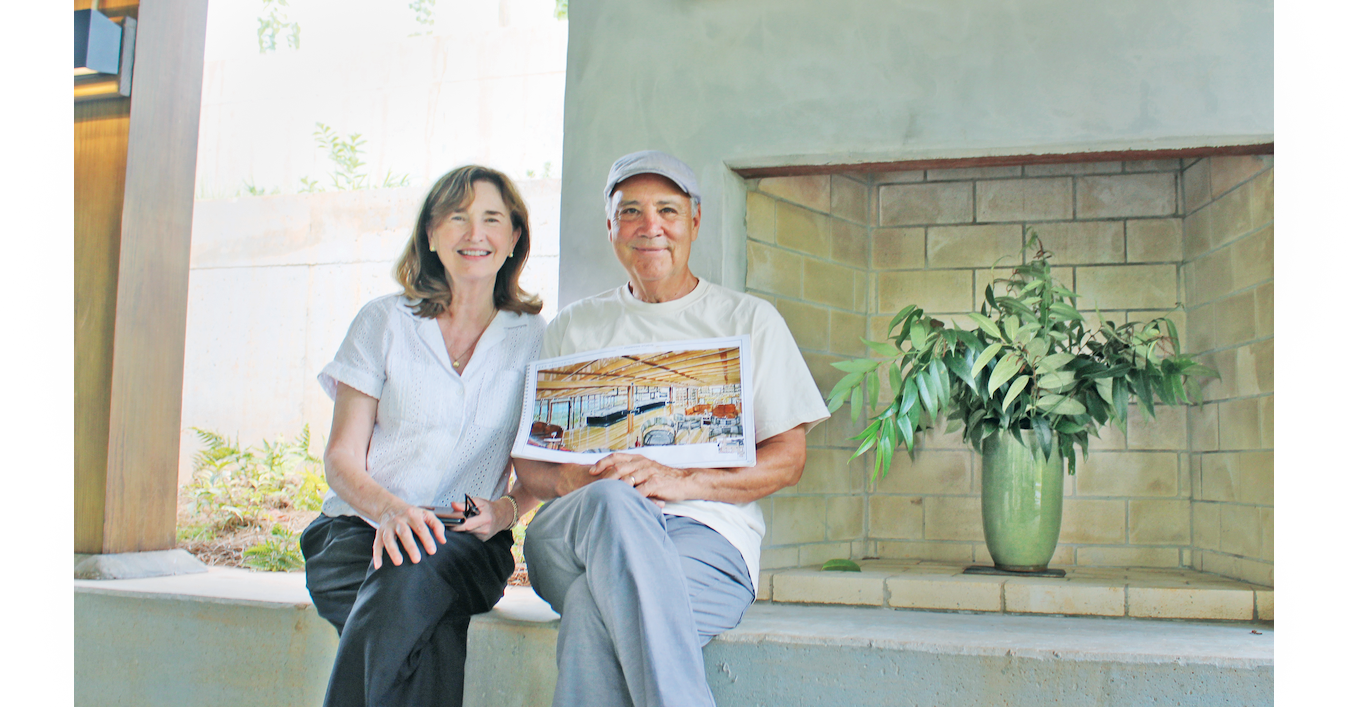
Sam Zamarripa and his wife Robin are the proprietors of Doghobble Wine Farm, a new 80-acre winery that just opened in the Dahlonega Plateau AVA (American Viticultural Area) in mid-June.
While the Zamarripas have already made numerous improvements to their property, including a large outdoor pavilion which serves as an outdoor tasting area, They want to let the community know that the best is yet to come.
Sam originally planned to demolish a 1972 farmhouse on the property, even going so far as to secure a demolition permit from the County, but decided instead to hire respected Atlanta architects Mack Scogin and Merrill Elam to design a complete renovation of the building to turn it into the winery’s new indoor tasting room.
“We can pay homage to the history of the place and its little slice of time in Lumpkin County and North Georgia and the way people lived, and then we are taking it into the future,” Sam said of the “high art” concept.
“We’re preserving it in a way that meets how we live now, and how hospitality is now. We think it’s going to be really beautiful,” he added.
PROPERTY TOUR
When The Nugget first arrived at Doghobble’s outdoor pavilion, Robin provided a little background on the property.
“We bought our land in 2019 during COVID and built our house and were kind of new to Dahlonega, and then this property was just kind of an edge property and Sam decided it would be interesting to own the ridge, too. And then one thing led to the next, and the next thing you know we were doing a winery,” she explained.
Robin said the Zamarripas will be planting their third vineyard on the property next spring, which will bring their total vineyard area to around nine acres.
She gestured out to the land stretching out in front of the pavilion.
“We call this the plateau: Doghobble plateau.”
Sam went on to explain the origin of the winery’s name.
“[Doghobble] is one of the most abundant plants on the eastern seaboard along creeks,” he said. “The name doghobble comes from the folklore that when bears were being pursued by dogs they’d lean into the doghobble because the doghobble was so thick they can’t get through. It hobbles the dogs. It’s even in Greco-Roman mythology.”
GROWING GRAPES
Sam said Doghobble Wine Farm winery only grows regional and local grape varieties.
“We’re not growing any California-style grapes. We are only sustainable grapes. We don’t grow anything that doesn’t grow here. And there are a lot of vines that don’t normally grow here.”
Sam said featured grapes include Norton, Lomanto, Chambourcin, Traminette, Vinoit and others.
“They’re suitable for our winter, they’re suitable for our summer, they’re suitable for our rain level, and they’re suitable for our humidity. Humidity is the biggest enemy of all the vines, because the mildews develop on the leaves and they shut down photosynthesis,” he explained.
He said while California-style grapes need to be sprayed 30 times a year, he only sprays four times a year.
“The two things we spray for are Japanese Beetles and powdery mildew,” he added.
PAWPAW POWER
Grapes aren’t the only fruit growing at Doghobble, however.
“We have a big stand of what are called pawpaw trees. We don’t know this to be true, but it’s a good marketing point: we have the largest pawpaw orchard in the southern United States,” Sam claimed.
He noted that pawpaw was at one time considered the heritage fruit of North America.
“It was indigenous, it grew in everybody’s yard. Your grandparents had one. And as fruits became commercialized, pawpaw had no shelf life, so it literally disappeared from the landscape. The University of Kentucky has picked it up in their horticulture program and today they’ve reintroduced an incalculable number of cultivars that are designed for climate and yield. We have twelve of them. And they’re three years in the ground,” he said.
Sam said the delicious “cult” fruit will be the subject of a future festival on the property.
“We should make the argument that Lumpkin County could be the pawpaw capital of the state because it grows abundantly along the Etowah [River] and all these creeks. And I can show you wild stands of it today.”
Sam said the winery grounds also host a persimmon orchard, as well as sheep, alpacas, donkeys and guinea hens.
FARMHOUSE RESCUE
Robin said at first, she and her husband strongly considered tearing the old farmhouse on the property down.
“But the farmhouse just sits there on the ridge so nicely when you pull up, we said ‘Let’s see if we can kind of incorporate that into the design,’” she recalled. “So it will be an enclosed, more traditional tasting room design, and we’ll keep this open [tasting area] outside.”
Sam jumped in to explain how much of the renovation has been completed so far. From an infrastructure standpoint, he said the house has been “fully reset.”
“So it has 21 new commercial footers under it, it has 600 amps of power. It has a brand new well and it has underground gas, fiber and water. It is, infrastructure-wise, ready, and the parking lot and all the stuff that used excavators is done. Now basically they’re going to pour the footings for the front porch and the back porch Friday, and then from there on out, it’s carpentry work.”
Sam expects the new facility to be completed by January of next year. He proudly showed off architectural plans for the new tasting room.
“This is not any architect, this is Scogin and Elam. Mack Scogin has been Dean of the School of Architecture at Harvard, and Merrill is on staff faculty at the University of Miami. But they are Atlanta folk heroes. They are the big deal.”
He said he and his wife had no idea what the final design would look like until it was completed.
“Our general interest is modern/rustic. They came to us with an idea to take the structure and to put a silo on the side for bathrooms, a pergola out front that mirrors our trellises, and to wrap this house in glass. So the 1972 farmhouse is going to be wrapped in glass, and all of the original construction of it exposed.”
He said both the silo and the pergola, which will match the Watson trellis system used to lift the grape vines up, will be “pretty dramatic” architectural features.
CULTURAL DESTINATION
Sam said his vineyard plans to begin hosting special educational events starting this Fall.
“The first event we’re having is we’re having the founder of White Oak Farms, a very famous farmer named Will Harris. He has 3,000 acres in southwest Georgia and just wrote a New York Times Bestseller on regenerative farming … He’s going to do a book reading here September 19,” he said.
Sam said he would like Doghobble to be a cultural destination rather than just another entertainment venue.
“We’re not looking to do a rock n' roll bar,” he said. “If we did music, I’d like to have the Lumpkin County High School Band do a recital here.”