
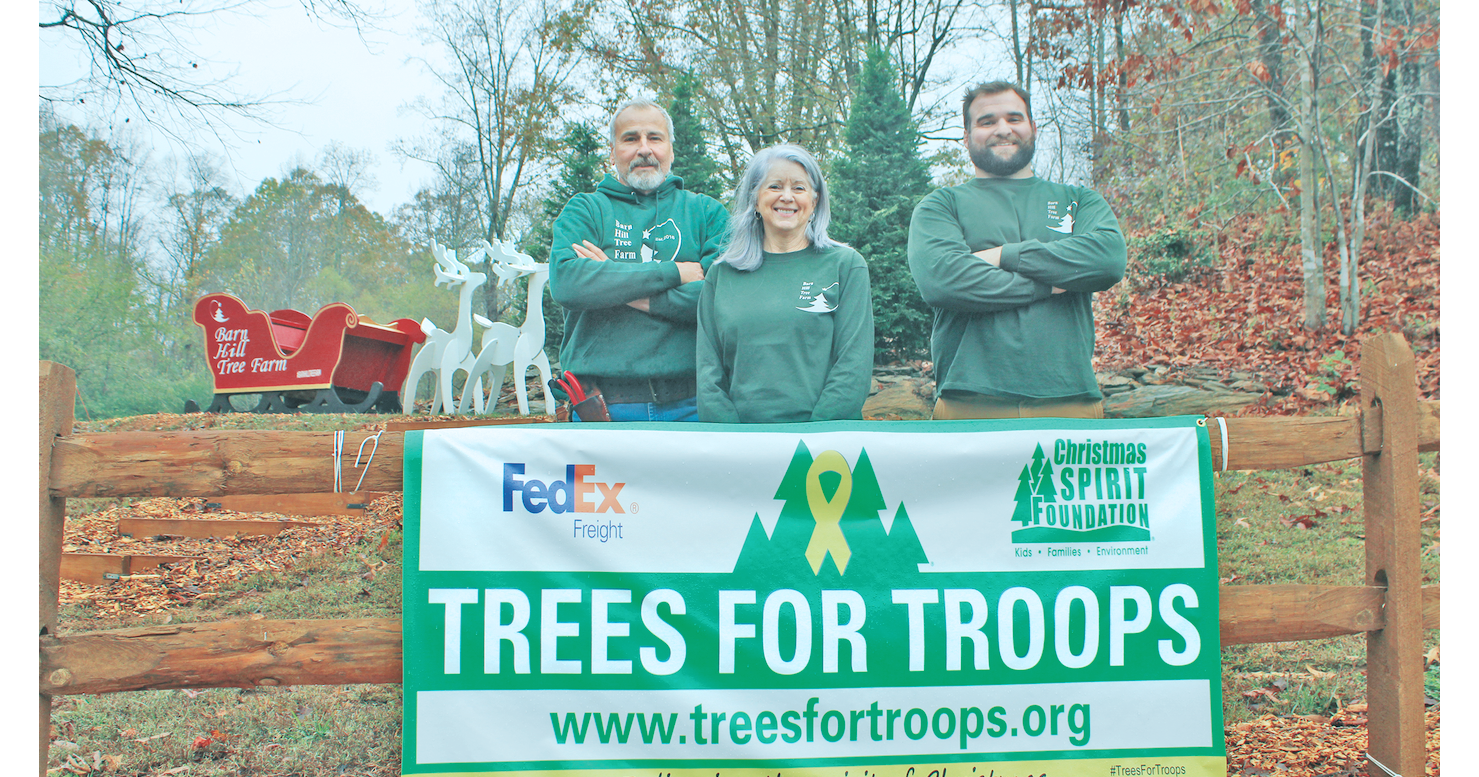
Giving back to the men and women of the U.S. military is a priority for local husband and wife entrepreneurs Ed and Linda Mannino.
In 2023, once their small Christmas tree growing operation, Barn Hill Tree Farm, had reached sufficient size to help spread some seasonal cheer to the troops, the Manninos were all in.
Ed serves on the board of the Georgia Christmas Tree Growers Association, which has been a participant in the annual Trees for Troops operation since it was founded in 2005 as a joint venture by FedEx and the National Christmas Tree Association.
Since then, the charity initiative has donated 293,392 complimentary, farm-grown Christmas trees to military families in the U.S. and troops deployed abroad. The effort has served 93 bases across all six military branches.
“There was one gentleman who was in the military who had experienced it, so he brought it to the [Georgia] association,” Linda recalled. “This was before we were involved. And every year we kind of talked about it, but we were really too small.”
Although Barn Hill Tree Farm was first planted in 2016, it did not open to the public until 2020.
Now, in its second year as an active participant in the program, Barn Hill is asking the public to join the patriotic effort by sponsoring a tree or making an online or in-person monetary donation in any amount.
“We feel like we’re very blessed to have what we have, and this is an option for us to give back,” Linda said.
One hundred percent of proceeds collected by Barn Hill Tree Farm benefit Trees for Troops, and since the National Christmas Tree Association is a 501(c)(3) charity, monetary donations are also tax deductible.
STARTING OUT
In addition to Ed and Linda, who are both retired, one of their five children, Matthew, also lives on the 30-acre property and helps out with the business.
“We have five acres in this valley that we’re developing for the farm,” Ed said.
The tree farm did not open to the public until 2020 because Christmas trees grow on a four to five year cycle, depending on factors like the amount of rainfall, and it took four years to get the first crop ready for harvest.
“We start out buying a tree in a one gallon pot from a grower and we nurture them up to three gallons,” Linda explained of the growing process. “Then, at the end of the selling season, we’ll pull stumps and plant new [trees] so that we have a rotating crop. We have a limited number of trees that we sell. We don’t ever want to sell our whole field because we want to cycle them in. That way you have trees every year that are anywhere from six foot to 12 foot trees,” she added.
Ed said the commercial aspect of the family farm came about largely by accident.
“We thought we would just plant trees and let our kids come out,” he said. “Then our kids told their friends, so it became a business very quickly for us.”
“And, with word of mouth, it’s just gotten bigger,” Linda added. “But our intention is to not become too commercialized … All of our children participate in the farm, and their kids. We’ve got our seventh grandchild on the way. And the littles have a blast. They’re always out here dressed as elves, running around handing out goodies to the other kids. It’s very family-oriented,” she said.
The first year the farm was open was a COVID year, which on the surface might appear to be a tough time to open a new business. But Linda says their business experienced the exact opposite.
“I believe because they were home and it was all about the family again and doing things, many people came out and it was a wonderful year,” she said.
GROWTH IMPEDIMENTS
Typically trees do not require additional watering, but lack of rain is one of the largest obstacles that can thwart Christmas tree growers.
“The first year that we planted was when we had a drought, in 2016. We actually bought big totes and hand-watered the trees,” Linda recalled.
“Since then we’ve been blessed. But we do have to fertilize and maintain the grounds around the trees. And three times a year we do big trimming, but we’re constantly pruning each tree to make it pretty. It is hard work and it is a year-round business. We have to nurture these trees year round to get them to grow,” she added.
Another recurring nightmare for Christmas tree farmers are deer.
“We do deal with a lot of deer damage out here. That’s another issue that a lot of the growers have,” Linda said.
Linda said the deer wait until the trees have reached a certain height before “scraping” them during rut season. The couple has even requested the assistance of hunters to help thin out the large native herd.
“We’ve tried so many different angles to help with that, but it’s just part of life. Because we have a lot of deer,” she said.
MEMORABLE EXPERIENCES
Linda said their Christmas tree farm is meant to provide a unique and meaningful holiday experience that the whole family can enjoy together.
“We have the fire pit and we give away marshmallows and hot chocolate, so people come and just kind of hang out. It’s more about the experience of getting a tree and letting the family participate. They can either cut it themselves, or, if they decide it’s too hard … we have a few others that we employ to come in and help harvest trees for people,” she said.
Employees will also bale the tree and assist the customer in getting it loaded onto their vehicle.
Linda described visiting the tree farm and experiencing the beauty of nature firsthand as “a little more personal than just picking out an artificial tree.”
And the young business is thriving, attracting visitors from all over the state and beyond, including many from the metro Atlanta area.
“We actually have one customer every year who comes from Tampa, Florida. We have several people that are coming to Dahlonega for the holidays and come by and get a tree. So it’s not only local,” Linda said.
She said many customers are visiting Dahlonega this time of year already for the Old Fashioned Christmas, so the tree farm, which is accessible from nearby Auraria Road, is a convenient activity.
“We’re close to town, so it kind of makes for a cool day of coming to get your Christmas tree and then going to town to shop,” she added.
This year’s opening day for customers will be Saturday, November 23. However, special arrangements can also be made by contacting the phone number listed on their website.
“We’re open on weekends starting next Saturday, and all that is on that webpage … We’ve also had people call, and if we weren’t open, we’ve opened up. We’ve had a few people come in and pick out a tree already and pay for it,” Ed noted.
Customers will need to know the specific size tree they need for their home.
“We start selling at six foot and it goes up. But sometimes we’re limited on the 11-foot trees we have. So the sooner they come to the farm, the better choice they’ll have,” Linda said
DIFFERENCE MAKERS
The Manninos noted that immediately after they began participating in Trees for Troops last year they met customers in the military who had actually received free trees courtesy of the program.
“There are several farms in Georgia that are drop-off locations, but the one we go to is in Cumming. We take our trees and they’re picked up by FedEx and then distributed out to the bases,” Linda explained. “There are actually trees from the Southeast that went all the way to Texas last year.”
As an added personal touch, the family places cards on each tree stating where it originated from, along with a simple note of encouragement.
Linda said patriotism is very important to the Mannino family.
“Both of our dads served in World War II, so we have a deep [military] history,” she said.
Linda said strong participation from the community will signal that Dahlonega “is supportive of the military.”
So far, the entire state has really come-through for the nationwide effort. In fact, two years ago, Georgia farms donated the largest percentage of trees of all the growers in the country.
“And that includes the big growers in North Carolina and Oregon. So Georgia was a really big participant in it,” Ed added.
And it’s not by accident. Georgia’s Christmas Tree Association has been pushing for 100 percent participation from all of the state’s tree farms.
There are multiple ways that residents can support this worthwhile effort, including making a donation in any amount or sponsoring a six-foot tree for $50.
“We have to do six foot trees because military homes are limited in space,” Linda explained.
The family is hopeful that even more people in the community will learn about Trees for Troops this year.
“I think a lot of people want to show appreciation [for the military] but don’t know how to do something that is direct. And this is very direct,” Linda said.
“We’d like to be one of the smaller farms, but give the most. If we can do that, that would be awesome,” she concluded.
For more information about purchasing a local Christmas tree or assisting in the Trees for Troops initiative, readers can visit Barn Hill Tree Farm on Facebook, Instagram or their own website, barnhilltreefarm.com.