
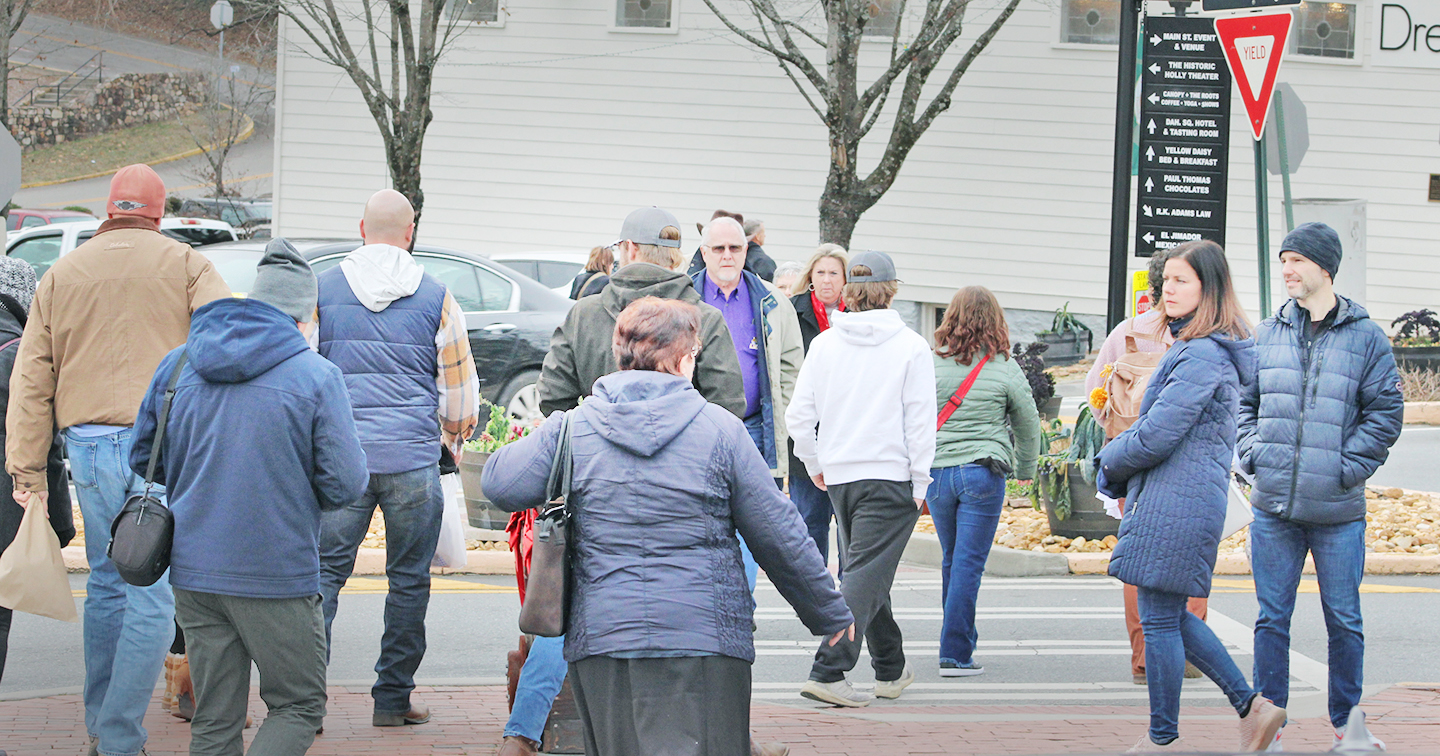
Tourism business is booming in Dahlonega. And Sam McDuffie brought the credit card receipts to prove it at two local meetings this month.
The Lumpkin County Tourism Director provided a behind-the-scenes look at spending stats during his annual report for fiscal year 2022 to the Dahlonega City Council and the Lumpkin County Board of Commissioners.
For starters, McDuffie noted in his dual presentations that Lumpkin is experiencing a competitive growth rate that places it fifth out of 34 counties in growth within the newly-designated Mountain Region.
“We’ve seen a 44 percent growth rate of visitor spending here in Lumpkin County. We’re in the top five of growth rate in 2021… I’ll be excited to see 2022 numbers,” McDuffie said.
As for actual spending, McDuffie had several interesting statistics to report thanks to a partnership with credit card tracking company Adara.
“We recently received a report from a company called Adara that looks over credit card expenditures. We were able to track almost $69 million dollars in credit card spending from tourists, directly. That’s anybody that does not have a 30533 zip code. We take [30533] out of the picture. That means it’s actually from visitor expenditures,” McDuffie explained.
The report compiled by Adara tracked the spending habits of 97,841 travelers across 347,241 transactions over the past year. Each traveler spent approximately $169.24 on a daily basis during their visits to the county. The average spend was $47.60 per transaction. The largest share of visitor spending came from area food stores and restaurants. Some of the top earners of tourist dollars in this category included Wal-Mart, Paul Thomas Chocolates, Gold City Growlers, Montaluce Winery, Shenanigan’s Irish Pub, and Rooster’s Cafe, among others.
McDuffie went on to explain how visitor spending benefits local residents in the community.
“If we did not have tourists in Dahlonega and Lumpkin County, every household would be paying $577 more on their taxes. So visitor direct tourism spending saves all of us Lumpkin County residents $577 a year,” McDuffie stated.
REACHING OUT
“I guess what’s mainly important is this year we’ve actually been able to put almost $300,000 into marketing Dahlonega and Lumpkin County due to the increase of hotel/motel tax,” said McDuffie as he outlined the efforts undertaken by the Dahlonega-Lumpkin County Chamber & Visitors Bureau over the last year to boost tourism to the area. He began by discussing a major advertising push that coincided with one of Georgia’s most iconic sporting events.
“We did the Augusta billboard this year during the Augusta Nationals. Huge success with that, it was right on the exit where the Masters was, on Exit 199 outside of Augusta,” McDuffie said.
McDuffie views billboards in general as an important tool for reaching out to Georgia travelers.
“We’ve got a billboard coming in from the south, in Chattanooga and Ringgold. We put a Discover Dahlonega billboard outside of Macon, Georgia, in Byron. We’ve got a billboard coming out of Birmingham, and we also have a billboard coming out of Greenville now. So we’re trying to catch everybody that’s coming to Dahlonega. When I was driving up the interstate this year I saw Pickens County, Alpine Helen, and Blue Ridge billboards, so it’s something [needed] to stay competitive in the industry,” McDuffie said.
Of course television is another big way to reach potential visitors, and Dahlonega is making its presence known in terms of both individual TV show episodes and commercials.
“We also have done two TV shows. The most recent is a T.V. show called ‘Wine First.’ It gets ten million views per episode, and that will go live in March. So we’re very excited about that, and that is a worldwide show through Georgia Public Broadcasting. We also did a show called ‘Fork in the Road’ which really focuses on the cultural history of Lumpkin County. We highlighted Big Creek Distillery, Red Oak Lavender, and a couple others,” McDuffie said.
As for more traditional forms of advertising, McDuffie said “We’ve done two [commercials] this year and we’re just wrapping up our third, which is going to focus on a winter commercial (mainly Christmas-oriented)… And then of course print advertisement: we’ve been in Southern Living, Atlanta Magazine, Explore Georgia (the state visitor guide that goes out to 200,000 people a year, and even with The Mountain Traveller which comes out with The Dahlonega Nugget.”
‘TRENDING UP’
McDuffie also had positive news to report regarding traffic to the tourism website Dahlonega.org.
“Our website has 1.1 million page views as of 10/31… we’re probably going to see an increase on that this year. So that’s pretty nice. And we’ve increased our average session duration of how long people spend on our website up to 2 minutes 23 seconds, and the average for the tourism industry is less than a minute. So we’re definitely getting people to stay on our websites. They’re intrigued with what we’re offering; they’re intrigued with our area,” McDuffie stated.
County Commissioner Bobby Mayfield indicated that he was particularly impressed with the web statistics.
“I used to do that for the county a long time ago, and 2 minutes and 23 seconds on a page is significant. That means someone is reading something or downloading something, and the fact that they have 2.85 pages per session means that [one] page took them to another page. So we’re serving our community very well with that website,” Mayfield said.
At McDuffie’s presentation before the city council, Councilman Johnny Ariemma asked what factors separate Lumpkin County from the fastest-growing county on the list, Fannin County.
“What they have that we don’t have is short-term rentals. They have over 1,400 short-term rentals in Fannin County alone. Lumpkin County has 248 short-term rentals,” McDuffie replied.
McDuffie also cited the limited number of available hotel rooms in Dahlonega as a limiting factor for growth in the county, but he expects that situation to improve over time.
“We only have about 840 rooms in the whole county. I think we’ll continue to see growth for the next couple years. Hopefully as the hospital opens up, and a few other things open up, I think we’ll probably see the number of rooms increase, and our hotel/motel tax [collections] will as well.”
McDuffie concluded his presentation to the city on a confident note.
“We’re definitely trending up, and I don’t think we’ve plateaued yet,” McDuffie said.