
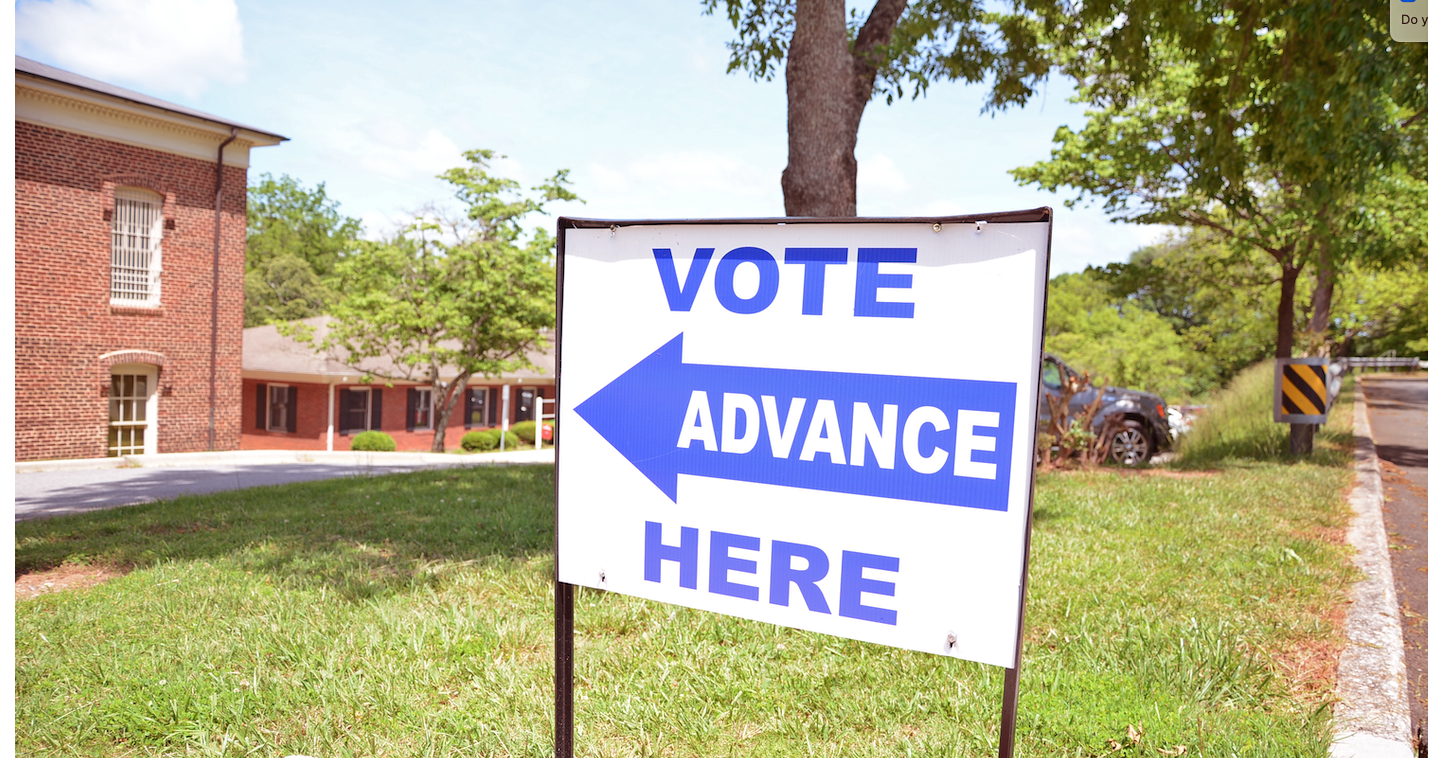
On March 18, Lumpkin voters will be asked to cast their votes in a special election to determine whether or not to continue the collection of E-SPLOST, a one penny sales used to raise funds for facility maintenance and provide technology and classroom resources for local students. The sixth iteration of the E-SPLOST (Education Special Purpose Local Option Sales Tax) is wrapping up its five-year duration early, after successfully raising the target amount of $25,000,000. E-SPLOST has been in effect in Lumpkin since the option was first established by the Georgia legislature in 1996.
E-SPLOST VII, if approved by voters, would continue the penny tax for another five years, or until a total of $38,200,000 has been collected, whichever comes first.
Funds from E-SPLOST can be used to cover non-salary expenses outlined in the ballot question, including building maintenance, bus fleet maintenance, curriculum upgrades and more.
Advance in-person voting for the single-issue election began at the Lumpkin County Elections Office, located at 56 Short Street, on Monday, February 24, and will continue through Friday, March 14, from 8:00 a.m. to 5:00 p.m. Election Day voting will take place from 7:00 a.m. to 7:00 p.m. on Tuesday, March 18, at the Parks & Rec Center at 365 Riley Road.
According to voter participation records available on lumpkincounty.gov, turnout for the special election has been sluggish so far. As of the end of the day on Monday, only 261 votes had been cast in person and eight absentee ballots had been accepted by mail.
Last Wednesday, The Nugget met with Lumpkin County Schools Superintendent Sharon Head, Associate Superintendent and Chief Operations Officer Greg Trammell and Chief Financial Officer Dr. Whittney McPherson to discuss the stakes of the upcoming special election and the importance of E-SPLOST collections to the system’s daily operations.
Other than state funding available through the Georgia capital outlay program, Trammell indicated that the school system has “no other source of funding to keep our schools up, besides E-SPLOST.”
BALLOT QUESTION
A sample ballot from the election, also available at the Elections & Registration website, provides potential voters with an opportunity to review the single ballot question before they enter the voting booth.
The yes-or-no question authorizes $38.2 million in sales tax collections over a five year period, with $12,534,047 earmarked for paying debt service on existing General Obligation Bonds and the other $25,665,953 available for use in one of seven different spending areas.
Those authorized uses include the acquisition or construction of new facilities, repair or upgrade of existing facilities, acquisition of school buses and the acquisition of technology equipment, textbooks, land or capital property.
Although Head indicated there are no plans to use funds from E-SPLOST VII to build any brand new facilities, Trammell said the description of proposed uses for the money was purposefully crafted to be as broad as possible.
“We’ve added as many things [as we can]. The more things that we can put into E-SPLOST, the less things we have to take out of our property tax dollars. So we try to capitalize, as much as the law will allow, to spend from E-SPLOST dollars,” he explained.
Unlike property taxes, sales taxes are collected from both local residents and visitors to the county alike, which helps share the funding burden.
When asked if administrators have a more detailed list of proposed future spending than the one featured on the ballot, Trammell indicated that planning sessions have determined very specific needs for flooring, painting, lighting and interior renovations.
“So we have that on a planning sheet, and you can’t list all that on a ballot, you know? The things that you would put on a ballot is if you’re going to build a new school, or if you’re going to do a huge project … But when you have multiple little things that you plan on doing … basically, it’s just to maintain the buildings,” Trammell said of the $25.6 million not specifically earmarked for debt service.
Head said the current iteration, E-SPLOST VI, was originally set to continue through Fall of 2026.
“We are actually going to collect early, which is a good thing. We’re going to hit the $25 million mark before that time, and that’s why we are taking E-SPLOST VII to the voters early. And my understanding of the way the process goes is it will just seamlessly continue if VII passes. You will go on into the next E-SPLOST, without there being a gap,” Head indicated.
DEBT SERVICE
Head told The Nugget that the school system will not be issuing any new bonds with funds from the next E-SPLOST, only paying off existing debt.
“The debt service amount, the $12 million, is for projects that have already been completed,” Trammell said.
“In the 2020 E-SPLOST, we issued General Obligation Bonds to build Cottrell [Elementary]. So now we have to make the payments on that,” McPherson added.
“So either you pay it through property taxes, or you can pay it through a sales tax. So [E-SPLOST] just removes things out of the General Fund budget that you need in order to operate,” McPherson said.
CRITICAL FUNDS
Trammell said having access to the remaining $25.6 million in E-SPLOST funds will help the system obtain important matching grants from the state.
“A lot of that money we’re going to collect is to match DOE [Department of Education] funds. Everything we do in facilities is through some kind of either Capital Outlay Program, which is for facilities, or through another funding mechanism for buses,” Trammell explained.
He said having matching funds to contribute to projects is critical to maintenance efforts.
“Currently, E-SPLOST is our only funding mechanism to take care of our buildings, to keep our technology up-to-date, to keep our safety features up-to-date, our bus fleet up-to-date.”
Trammell said technology and safety needs have evolved dramatically during his time with the school system, and will continue to do so.
“I’ve gone from [having] no cameras in our schools to VCRs, and now we can pull them up and look at them on the phone if we need to, and record facial identification. You want the best prevention technologies in your schools, for your kids’ sake. We use that E-SPLOST to try to stay ahead of the game where that’s concerned,” Trammell added.
McPherson also gave the example of a recent state-mandated change to curriculum that required new textbook adoption.
“We had to buy an entire new curriculum to meet the literacy legislation, and that’s $600,000 [worth] of curriculum that would have otherwise come out of the General Fund, but we’re able to purchase through E-SPLOST because we write textbooks into our E-SPLOST,” McPherson said.
Trammell said there would be no easy way to replace the funds that an E-SPLOST sales tax generates for the school system.
“Our deal is just taking care of kids, and this E-SPLOST provides a service level that we would not be able to provide if we didn’t have it. There’s just no way we could piggyback the taxpayers for the amount of money that we could collect from E-SPLOST,” Trammell concluded.