
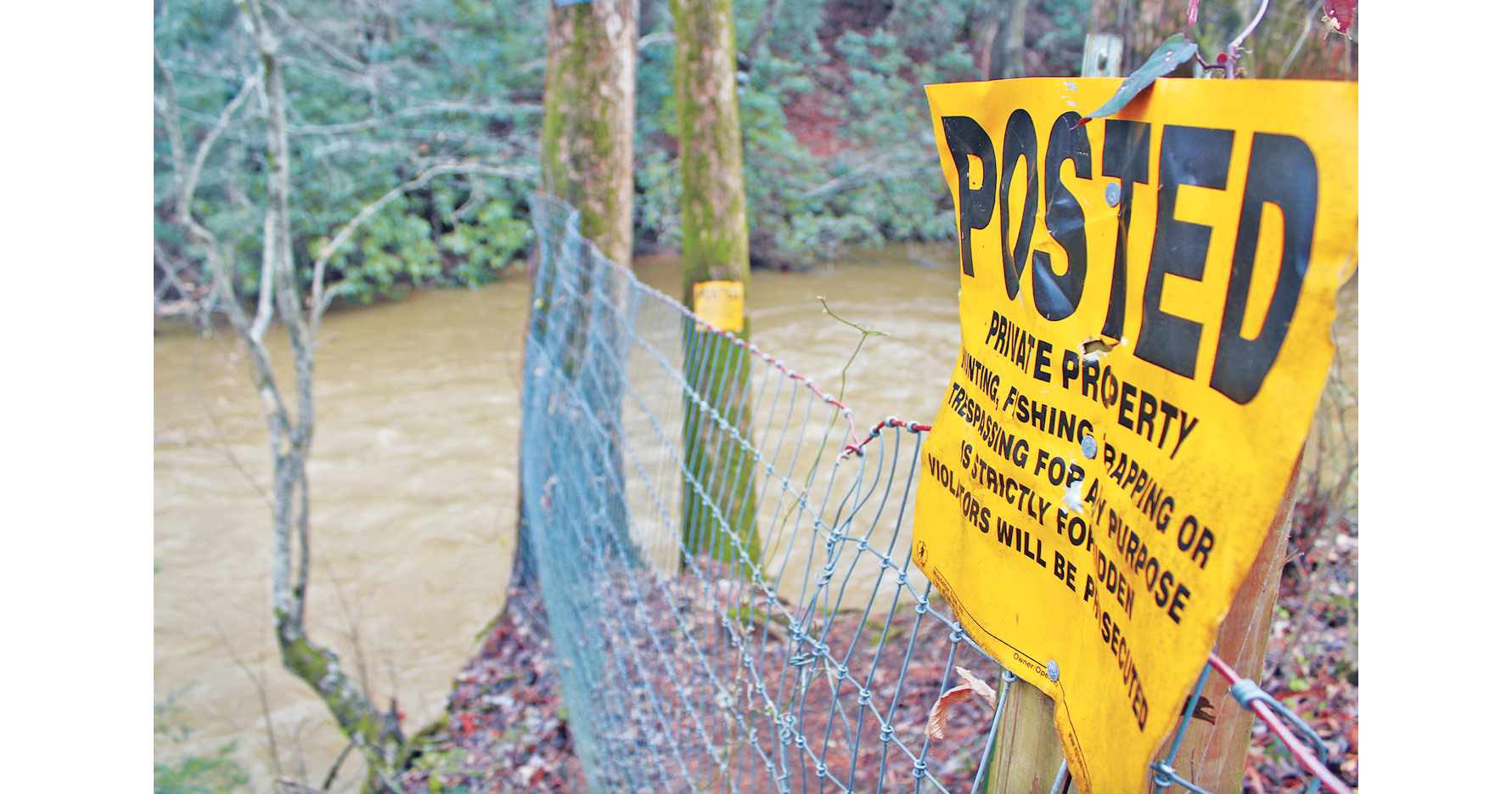
North Georgia area paddlers and fishermen concerned about losing future access to outdoor recreation were provided with no additional clarity after a December 2 final report of the Georgia House Study Committee on Navigable Streams and Related Matters.
The report recommended no further changes to the definition of navigability in state law, while also recommending to the General Assembly that they refrain from adopting a specific list of which streams in Georgia are considered navigable and which are not.
The recommendations come after House Bill 1172 was signed into law by the governor on May 6 and took effect on July 1, 2024.
The purpose of that law was to codify public fishing rights after a Flint River property owner banned fishing there and sued the state to enforce it.
However, critics say the new law leaves local outdoor enthusiasts with a less than clear picture of which waterways in the state they have a legal right to access.
In the wake of the study committee’s report, The Nugget reached out to Appalachian Outfitters owner Ben LaChance, Lumpkin County Sheriff Stacy Jarrard and state Senator Steve Gooch for their opinions on the committee’s recommendations, and the future of fishing and floating in the state going forward.
RESIDENT EXPERT
LaChance recently stopped by The Nugget office to give his take on the House Study Committee and its findings.
“First of all, I appreciate the fact that the state even put together a study committee,” he said at the start of the conversation.
“But let’s tell it like it is,” LaChance continued. “In the state of Georgia it’s impossible, or very difficult, to have a one-size-fits-all navigability status for the entire State.”
He said the proposed list of navigable streams “was done in the short-term by very well-meaning people on this study [committee] that haven’t got a clue about the state or its waters. It is so hard to define the watersheds of north Georgia, middle Georgia and the Piedmont, those that are titled flow rivers. Most of those that are closer to the coast get affected by the 1863 ruling,” he noted, referring to the 1863 Georgia Navigability Code that established that the owner of the adjacent land owns the stream bed and has exclusive possession of it.
LaChance said many outdoor enthusiasts in the state would like to see that law tossed out. As for providing a list of navigable streams in the state, he said legislators’ efforts missed the mark, despite the fact that the Chestatee River would have been labeled as navigable below Tesnatee Creek.
“When we saw the list, sure, Applachian Outfitters and Rhett [Stringer] at Chestatee River Adventures could breathe easier,” he admitted.
But he said too many other rivers and streams were senselessly excluded from the list.
“It didn’t look like it had been well-researched.”
LaChance said the most egregious omissions from the navigable list were waterways that have boat ramps and launch sites developed and maintained by the state’s own Department of Natural Resources.
“How in the world do you miss that?” he asked rhetorically.
But LaChance said that even if the list was more exhaustive, there would still be landowners contesting it.
“That could still happen. No one’s going to be safe, even if they define it that way,” he argued.
He said another misguided approach examined by the study committee is to define navigability by a river or stream’s average annual water flow, as measured in cubic feet per second (cfs).
“They came up with this random number of an annual flow of 400 cfs on average … That sent shockwaves amongst paddlers, and it was one of the main things I spoke against at the meeting at Unicoi. How ridiculous that was! Again, it showed the committee had no concept of the rivers and their diversity,” LaChance continued.
He pointed out that the Chestatee River “couldn’t possibly be over 200 cfs, and that’s on a wet year.”
“Most of the time we run at 150 cfs, and I’m happy with it. As a matter of fact, when it gets to four or five hundred I start telling people ‘Let’s wait another day.’ We can’t do any kind of tubing at all with that cfs,” he indicated.
LaChance said the committee could benefit from “a different expertise.”
“They’re good people,” he said of its members. “They were listening … They were all asking the right questions. But when it came down to it … I don’t think they could spend enough time researching that. DNR’s got a lot of weight possibly being put on them as far as the enforcement mode, and that’s going to be difficult.”
LaChance also responded to an idea by Georgia Rivers coordinator Joe Cook, who suggested that the committee should consider separating paddling rights from hunting and fishing rights.
“The right of passage is independent of laws relating to navigability,” he told the committee during their final November 13 meeting.
But LaChance doesn’t see how the two activities can be untethered.
“Speaking from a personal view of watching people launch on the Chestatee, a good 20 percent of people take fishing poles,” he said. “It’s going to happen.”
“I’ve talked to Joe about this a lot, and I think, as a cause, that fisherman and boaters and maybe in some cases hunters for south Georgia, really need to band together,” he continued.
Despite his criticisms, LaChance hopes the work of the study committee is not finished.
“I hope this is just the beginning and will lead to further investigation,” he said.
He believes the correct question for the committee to ask is why other neighboring states like North Carolina, South Carolina, Alabama and Florida do not have the same confusion surrounding navigability.
In his mind the difference is that in these states the “navigability test” is simply defined as whether or not you can navigate a waterway.
“It doesn’t matter what kind of craft you’re in. It doesn’t have anything to do with commercial freight,” he said.
LOCAL ENFORCEMENT
Lumpkin County Sheriff Stacy Jarrard said he was not personally familiar with the report from the House Study Committee.
He said as long as the law remains the same, he would honor a County landowner’s request for assistance as long as it’s a non-navigable waterway.
The question is, how does his department define that?
“What I’d have to do now, I’d have to look and see what the committee said and then I’d have to reach out to DNR and see how they’re gong to respond with that. And then I would ask them to give us the definition of what waters in Lumpkin County are navigable and what waters are non-navigable, and then we would pursue from there,” Jarrard said, indicating that ideally this would be done before the first call comes in.
“The areas that are non-navigable, if those landowners call, then that’s when we would issue trespassing notices,” Jarrard added.
SENATE LEADERSHIP
“It is complicated,” Senator Gooch admitted to The Nugget over the phone. But he said he wanted to make it clear that the state laws as they relate to navigability have not actually changed.
“The definition is defined in the constitution and state law. It’s also been adjudicated in courts over the 200+ years that Georgia has been a state. So that has not changed,” he said.
He believes the sheriff’s approach to a hypothetical dispute is correct.
“If someone comes on to your property and you don’t want them on your property, you have a right to ask them to leave and a right to call 911 and ask the sheriff’s department for them to leave as well. Nothing is different today than 20 years ago,” Gooch said.
He pointed out that the issue is complicated by the differences between north and south Georgia waterways.
“Water lines are important down there, because the property lines go down to where the vegetation rests in those areas. Those are more known as what is navigable streams, because they are deep channels and the water comes up and down [with the ebb and flow of the tide]. That’s where the navigation part comes in, as far as transporting commerce,” Gooch said.
“In north Georgia, the property lines go to the center of the streams,” he continued. “The property owner has a deed to the dirt underneath the riverbed to the center of the stream, if they own the property on one side. They don’t own the waters, because those are state waters. But as far as the land goes, it goes to the person who pays the property taxes and whose name is on the deed.”
He said if you interpret the law as it is written and defined by the courts, virtually no north Georgia streams would qualify as navigable.
“If DNR has a list of those streams that the sheriff can use, I guess at some point it may end up in court again to determine if that list holds water, no pun intended,” Gooch added, noting that what is considered navigable today is much different than in the 1700s.
“To be honest, it may require a court action from the higher court to ever really determine what the definition would be, applied in today’s terminology and world,” he said.
As Majority Leader, Gooch does not believe there’s an appetite in the state Senate to change a law that has been sitting on the books for over two centuries “unless the court system comes up with an interpretation that we don’t like.”
“We represent the people of Georgia. The biggest thing that I think we stand for in our duties as a sworn elected official is to uphold the laws of Georgia and protect the constitutional rights of every Georgian. In that constitution it is very clear that private property rights are a solid foundation of our state government and constitution,” he concluded.