
The political dominoes continue to fall across north Georgia following the recent announcement by State Senator Steve Gooch that he will be running for Lieutenant Governor of Georgia in 2026.
Last week, Representative Will Wade announced his intention to run for Gooch’s Senate seat.
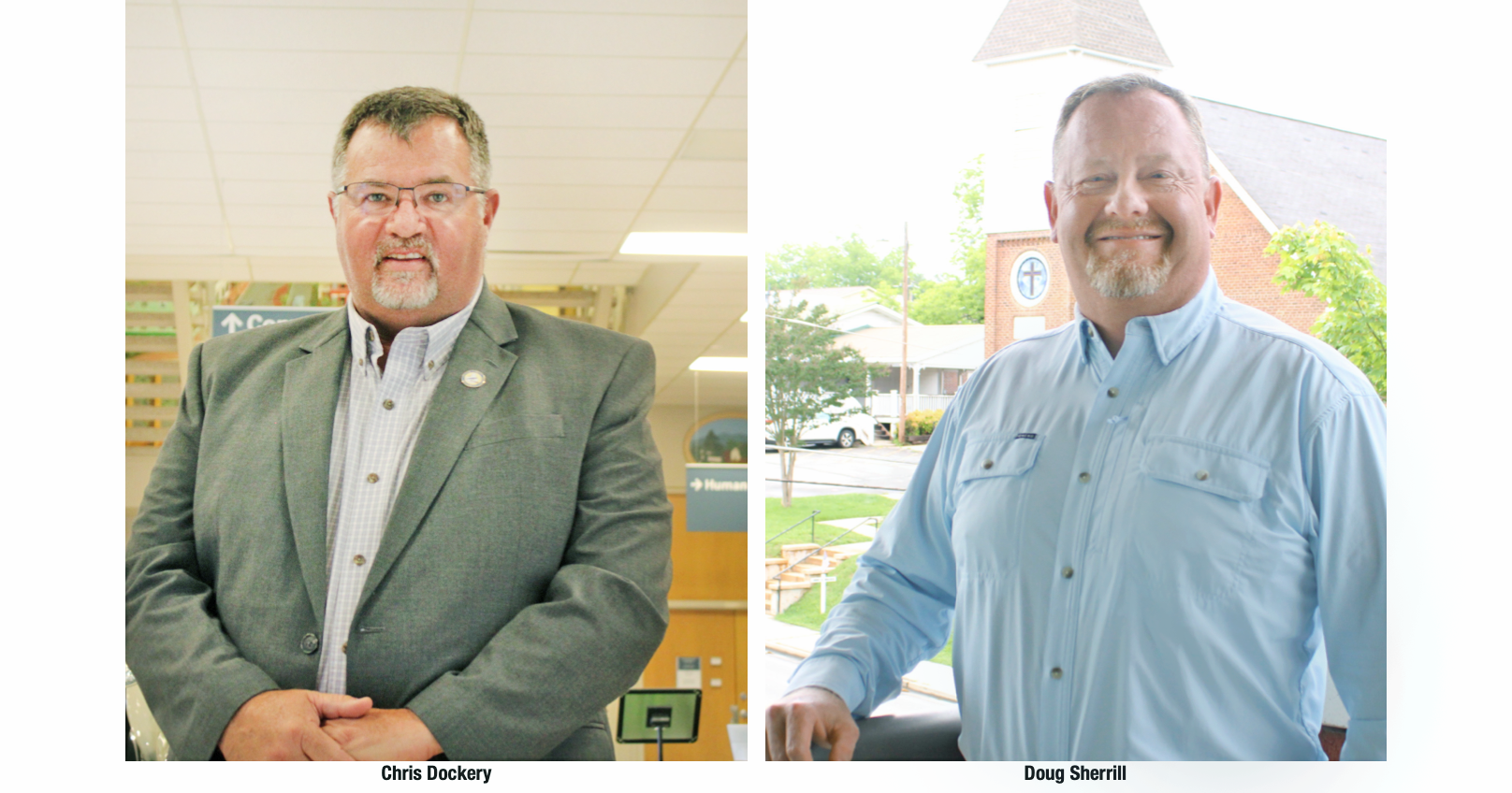
Now, two local leaders have declared that they will campaign for Wade’s open District 9 House seat: Lumpkin County Board of Commissioners Chairman Chris Dockery, and Dawson County business owner and former Lumpkin County Commissioner Doug Sherrill.
Both men sat down for separate interviews with The Nugget last week to discuss their decisions to run and what they each hope to accomplish if elected to the lower house of the Georgia General Assembly.
CHRIS DOCKERY
Dockery graduated from the University of North Georgia and commissioned as a Second Lieutenant in the Army National Guard.
Dockery also served as a law enforcement officer for six years before starting his own contracting business, DockCo Construction, in 1996.
Unlike Rep. Wade and Sen. Gooch, who will both be able to complete their current terms ahead of next year’s campaign, Dockery was just re-elected to a fourth four-year term last November.
“The qualification for House District 9 will be sometime next March. At that time, when I officially qualify to run for that office, I will have to resign my position as the Chairman of the Board of Commissioners,” Dockery confirmed.
Dockery said there will be a special election sometime next year to select his replacement on the board.
“I think the timing of that is up in the air. They may hold that election in conjunction with another special election, not only for the sake of participation, but for the sake of cost. That would certainly be the goal,” he continued.
Dockery said he must resign in March as soon as he qualifies for his House run, but also indicated that he is willing to vacate his seat a little early if it will help save the taxpayers money.
Dockery said he has already hired a political consultant and a fundraiser, and intends to “hit the campaign trail hard” once the race officially begins.
When asked if it was difficult to give up his current position to make a House run, Dockery said it was not something he took lightly.
“It’s a decision I’ve prayed about, I’ve pondered, and I feel like it’s just the right decision for me,” he said.
Dockery said he is proud of what the local Board of Commissioners has accomplished during his tenure.
“But you know, at some point you have to ask yourself—Is it time to get fresh ideas? Is it time to move on?” he added.
Dockery said he is well-positioned to win over voters in all three of the district’s counties: Lumpkin, Dawson and White.
“As it relates to White County, I grew up in the area of White County in House District 9, so I feel like I have a lot of contacts there,” he continued. “And Dawson County is a big county. It’s about the same size as Lumpkin County. But you know, I’ve got lots of contacts, friends and associates in the Dawson County community that have already reached out to me and said ‘Let us know what we need to do.’”
Dockery, who was recently selected to receive the coveted Emory Greene Leadership Award from the Association of County Commissioners of Georgia (ACCG), believes his policy work with that organization has helped prepare him to work in the state Capitol.
“It’s an organization that represents all 159 counties in the state of Georgia. And every year, ACCG’s policy team will track legislation that’s being crafted throughout the year and discuss how it affects counties. So part of that process is to travel all over the state and hear from different county commissioners, because no two counties are the same. So legislation that might be neutral in one county could have a devastating effect in another county,” he said.
As a member of ACCG’s policy council, Dockery has helped prioritize proposed legislation that will benefit Georgia’s county governments.
He said the council meets weekly via Zoom and gathers updates from lawmakers on pending legislation and how it’s progressing in the Capitol.
“One thing I’ve learned in my tenure is there is just as much that goes on outside the county that affects the County government and the people … as there is inside the boundaries of Lumpkin County. That’s one reason that I’m passionate about going back to the Capitol, is to continue to look after not only Lumpkin County’s interests, but the interests of Lumpkin, Dawson, White and the interests of north Georgia as a whole,” he said.
Dockery acknowledged that moving from the five-member Board of Commissioners to the 180-member House would be an adjustment, but he believes he is in a solid position to succeed there.
“Through my work with ACCG and my appointment to various committees at the state level, I feel like I have relationships already established within the House of Representatives and the Senate. And I’ve had members of both the House and the Senate that have already reached out to me and said ‘Let me know what I can do to help,’” he said.
When asked what his priorities would be in the House, Dockery listed property rights, which he called “the fundamental principle of the Republican Party,” along with cutting taxes and enhancing education, transportation and veterans’ services.
Dockery supports a phased elimination of the state income tax, adding personal finance to the state curriculum, and advocating for regional infrastructure projects.
DOUG SHERRILL
Sherrill has been a resident of the City of Dahlonega since 2012, but he has lived in Lumpkin County since 1995.
He operates two businesses in Dawson County: Stratus Mapping and Land Development Professionals. The first specializes in drone mapping and LiDAR [Light Detection and Ranging] technology, while the latter specializes in survey site development.
Sherrill has previously held public office two times, once as Lumpkin County Surveyor and once as a Lumpkin County Commissioner.
He believes that local property taxes are still out of control.
“House Bill 581 was a good first step. The downside of that was the fact that the state was having to get involved locally to limit local taxation to just above the inflation rate. Our taxes went up eight percent this year. HB 581 will need improvement,” Sherrill said, indicating his belief that additional patches are required other than the ones that passed during the 2025 legislative session.
As a county commissioner, Sherrill said he learned that “you become an island unto yourself on those commission seats” when standing up for your constituents.
In a press release announcing his candidacy, Sherrill said the District 9 seat “belongs to the people—not the politicians,” and that he is running for “all those who feel left behind by out-of-touch leadership.”
When asked to elaborate on that statement, Sherrill called out “those that use these positions as stepping stones for the next position.”
“This is not a stepping stone for me. I truly want to represent my constituency on an ideological basis. With my background, there is no question among my supporters—I do not carry the label of a ‘RINO’ [Republican In Name Only]. I’m going to be running against RINOs,” he said, arguing that he has “never faltered or wavered” in his views on economic or social issues.
Regarding local land use and development, Sherrill said the problem that local leaders refuse to acknowledge is that Dawson County “currently has a moratorium in place for development.”
“Those developments are going to skip over Dawson County, and they are now headed to Lumpkin County, and Lumpkin is not ready for this … I see it because I’m there in the trenches, talking to these developers, seeing what they’re anticipating. They read ordinances. They look at zoning regs. That’s how they determine where to build and what to build,” he said.
Sherrill said he believes the state government can have a constructive role in fostering regional strategies designed to handle growth.
“I’m an influencer in the sense that I know the actors. I know all the agencies. I know the political leaders of the communities. I can help foster and bring these groups together to think communally,” he said.
Sherrill also called for a “collective endeavor” to tackle growing traffic problems at the end of GA 400.
In addition to taxation and development, Sherrill indicated that his campaign will also focus on conservative social issues at the state level.
Sherrill said he would float two specific bills, modeled after legislation in nearby states, to curb child abuse and child sexual exploitation.
The first is legislation from the state of Louisiana allowing judges to impose physical or chemical castration on anyone who sexually abuses a child 12 or under.
“And the other is requiring an age verification for pornography online. The state of North Carolina has such a bill,” he said.
That would mean visitors to a pornographic website would have to do more than simply click a button to prove that they are over 18.
“There would be an additional verification process. And they do not keep a database of your info when they verify. It would be illegal for them to house that, or store it,” Sherrill emphasized.
In addition, there are other issues that have been popular among Republican lawmakers that Sherrill said he would continue to change.
“Men in women’s sports, funding transgender surgery procedures in the prisons using public funds, I want to eliminate that. And I want to go further in working on Tort Reform,” he said.