
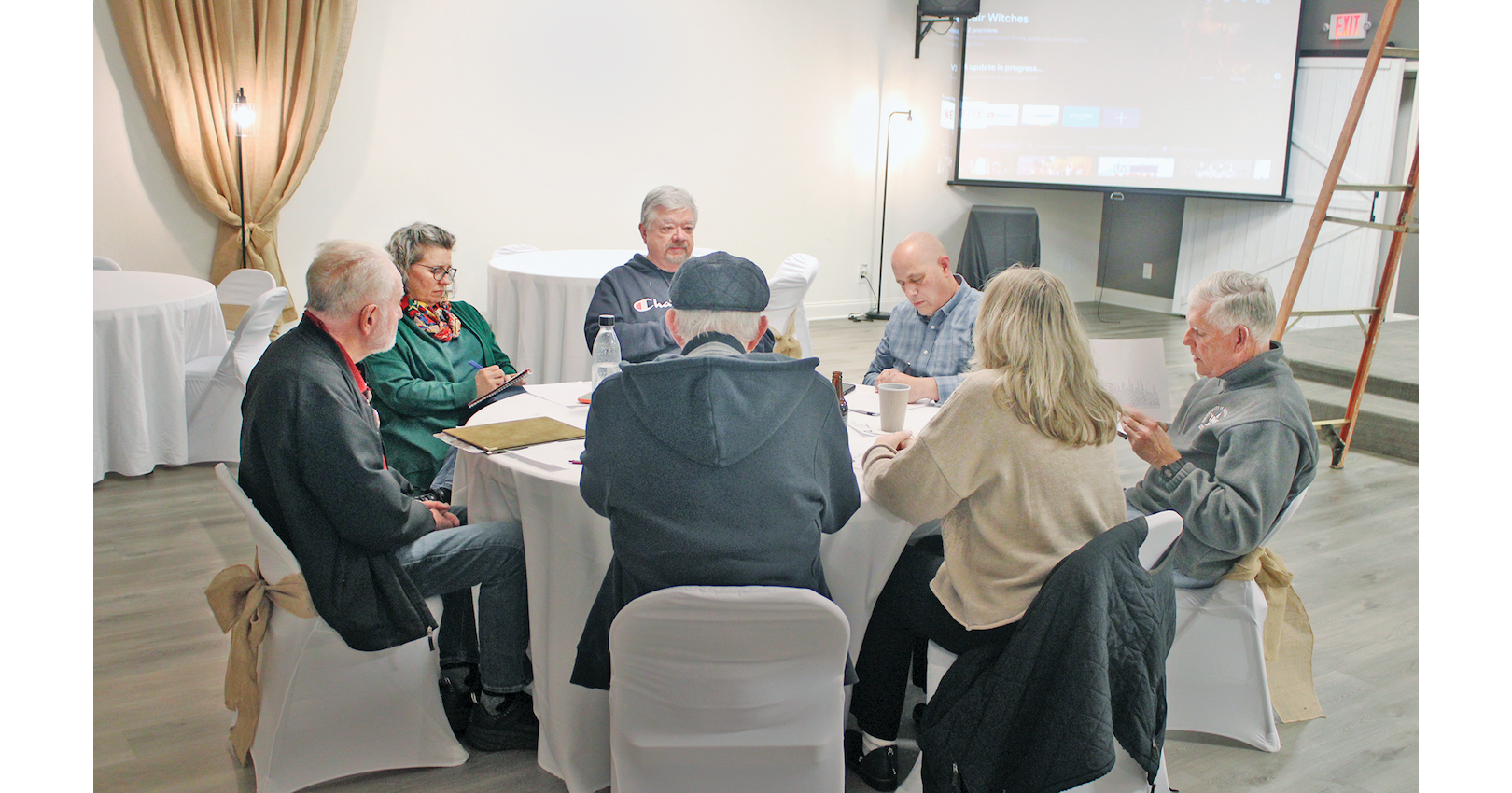
The Lumpkin County Native American Advisory Committee met last Thursday to develop a recommendation on the aesthetics of the new County park set to be built on Rock House Road next year.
The committee, established last September, was tasked with taking a general concept created under the direction of the Reservoir Committee and seeking ways to memorialize Native American heritage in the area.
County Commissioner Jeff Moran serves as the committee chair, alongside fellow members Ken Akins, Glenn Jones, Rhonda Bennett, Ross Shirley, Jimmy Anderson, Dr. Tamara Spike and Senator Steve Gooch. Gooch was unable to attend the most recent meeting due to a scheduling conflict.
After an hour of discussion, the committee reached a consensus that the two pavilions and accompanying restroom facilities shown on the Reservoir Committee’s plan should be built using modern methods and materials due to maintenance requirements.
However, members also repeatedly expressed their desire that an additional primitive recreational area be added inside the new park that would allow for the construction of temporary or semi-permanent exhibits by outside volunteer groups using authentic materials.
The group also discussed ideas for Native American interpretive signage, artifact displays and community educational opportunities that could be added to the new park or the greater reservoir area, potentially in phases.
UNDER PRESSURE
After calling the meeting to order, Moran said that the committee would have to make some decisions regarding the appearance of buildings on the site plan.
He said the committee would also be expanding to two meetings a month until they could get everything finalized.
“We’ve done a lot of presentations, which is great, but we’ve got to actually make some progress because next month we have to present the hardscape to the Reservoir Committee. So it’s going to go from here to the Reservoir Committee briefly for a recommendation from them, and then it’s going to the Board of Commissioners once we’re done,” Moran continued.
He noted that there had been some changes to the park layout after the last Reservoir Committee meeting.
“Yeah, that’s what kind of surprised me when I read the article the other day,” Shirley said of a January 1 Nugget article summarizing the meeting. “I didn’t know that they were that far along with putting some of the structures in, and the layout.”
Moran also pointed out that Native American burial sites were mentioned at the meeting.
“That interested me. I didn’t know there was anything like that,” Akins chimed in. “Has anyone done any research on it? Do they actually know that they are Indian graves?” he asked.
Bennet said she could probably recruit an anthropologist or archaeologist, but Akins said the County might need to utilize ground-penetrating radar so that they don’t have to dig.
Moran said he wanted to see what action the Reservoir Committee was already taking, since the issue was first brought up during their meeting.
UNNAMED PARK
Akins said he had done some research on possible Cherokee names for the new park, and suggested the native language should be used.
But Bennet said she didn’t think many people would know who the park was honoring unless the word “Cherokee” was included.
“Could we call it the ‘Cherokee Heritage Park?’ Bennet asked.
Anderson was not sold on the idea.
“Well let me just say though, and I guess we’re not all on the same page on this, this is the Native American Advisory Committee. It doesn’t say ‘Cherokee Advisory Committee.’ I thought this was supposed to represent all [local tribes],” Anderson said.
Akins agreed, but suggested the other tribes could be noted in the park’s interpretive signage instead.
“I think we should at least have it interpreted that the Muscogee Creek were here first,” he recommended, noting that the Cherokee didn’t come to the area until around the mid-1700s.
“The Cherokee were the prominent people here, but they weren’t the only ones,” Anderson agreed.
Akins said signage could reflect that the original inhabitants were Muscogee Creek until the Cherokee took over in a series of bloody battles, but he still believes the committee should ‘zero in on the Cherokee, because they were the prominent Indian tribe.’
Bennet asked if there were any other tribes in the area, besides the Creek.
Spike said there were definitely other peoples here, but they were disconnected from modern groups.
Shirley agreed with Bennet that the word “Cherokee” should probably be included in the name, since they had the longest known presence.
Moran agreed that the committee’s charter is mainly focused on recognizing Cherokee heritage in the area, but said establishing the new park’s name was not the group’s highest priority at the moment.
PAVILION
Moran said he had some reservations about recommending a traditional Cherokee seven-sided building for the two planned pavilions, as discussed in the group’s prior meetings.
“It’s got to be functional. If you have the seven-sided building with all of the benches going down to the center, it’s just not going to be used by the public every day for picnics and hanging out,” Moran said.
“The other thing is the maintenance on a building like that. It’s high maintenance,” Jones added.
Moran agreed. He said he talked to the County about setting aside a small footprint on the property for other educational construction projects.
“I don’t know if they would be temporary or not, like a dob hut. If people build that we could maybe put a sign there describing it and people can do classes,” he added.
At that point Akins fired up an overhead slideshow presentation of different seven-sided buildings at other Native American sites. Some were built for historical accuracy, while others were built with greater functionality and durability in mind.
“That’s the one at [Southern] Adventist University,” Akins said, showing a structure made with regular pressure-treated boards on the university’s Tennessee campus. “It was built with modern material, as you can see. And they use it a lot.”
The modern seven-sided building was made with modern two-by-four and four-by-four boards, with three seating levels and a metal fire ring in the middle with an accompanying hole in the center of the roof for ventilation.
However, Akins said instead of pressure-treated wood, he would personally like to see a mix of authentic and hybrid materials used.
“At Etowah [Mounds], we use artificial grass on the roof. It made a big difference for maintenance. And the dob is not only clay. If we just used clay it would wash. We put concrete in it. You couldn’t tell that it had mortar mix, and it hardened to the point that it never was a maintenance problem,” he said.
Akins said a group of volunteers equipped with the right raw materials could do the job themselves without a contractor.
“It’s just unbelievable what they did with cane … We could get cane from the original cane break and build a wattle and daub Council House or something like that with it. It’s not very hard to do, it really isn’t,” Akins said.
“All we need is hardwood saplings. You put tar on the part that goes in the ground. You won’t believe how long that keeps it … The Etowah wattle and daub that was built in 2006 or 2007 is still there. There’s very little they’ve had to do to it except for the roof,” he continued.
Bennett said she knew a local Boy Scout group who would be excited to volunteer for such a project, if it were authorized.
Moran said the bulk of maintenance would be performed by Parks & Rec personnel, and the County could not rely on an outside group like the Boy Scouts for regular maintenance of the taxpayer-funded pavilions.
But he said something more reminiscent of an actual Cherokee Council House could be built in an earmarked primitive area and privately maintained, and that the greater reservoir property could possibly be used for other memorial opportunities as well.
ADDITIONAL IDEAS
One of the recurring themes in Akin’s presentation was interpretive signage throughout the property that would describe the language, food, animals and clothing of the Cherokee Indians.
Spike suggested some kind of self-guided tour, where a visitor can follow an individual narrator’s life story through a series of informative signs and historical displays.
Shirley said he found that idea of merging the visitor’s adventure with the experience of a historical character “intriguing.”
“I really like this idea of intertwining them, almost as if they’re on a journey, so to speak.”
Bennet recommended trying to plant some native American Chestnut trees in the park, as well.
“I’m sure the American Chestnut Society would be thrilled to have somewhere to experiment. That’s what their whole purpose is, preserving natural wonders,” Akins agreed.
Anderson said that a Native American artifact display could also be a worthwhile addition to the park.
“I feel like there are a lot of artifacts stuffed back in drawers around this area,” he said.
“A lot of people, I think, would be glad to donate to something like what we are doing if they feel comfortable knowing it’s not going to be stuck in another drawer someplace for another generation.”
But Spike questioned whether the park would have adequate security for artifact displays.
She suggested expanding the restroom buildings slightly for a display area that could be easily locked at night, along with the rest of the building.
COMMITTEE CONSENSUS
“So are we in consensus here that we’re going to build the structures with current methods and materials and see if an architect can put some touches to make it look authentic?” asked Moran near the end of the meeting.
Akins agreed, but reiterated his desire for a primitive recreation area also.
“Anything else?” Moran asked the group.
Akins said he would like to tour the proposed site firsthand, and the committee agreed.
Later, Deputy County Clerk Helen Miller confirmed via e-mail that the Native American Committee’s next meeting will take place at the Rock House Road site on Thursday, January 23 at 4 p.m.