
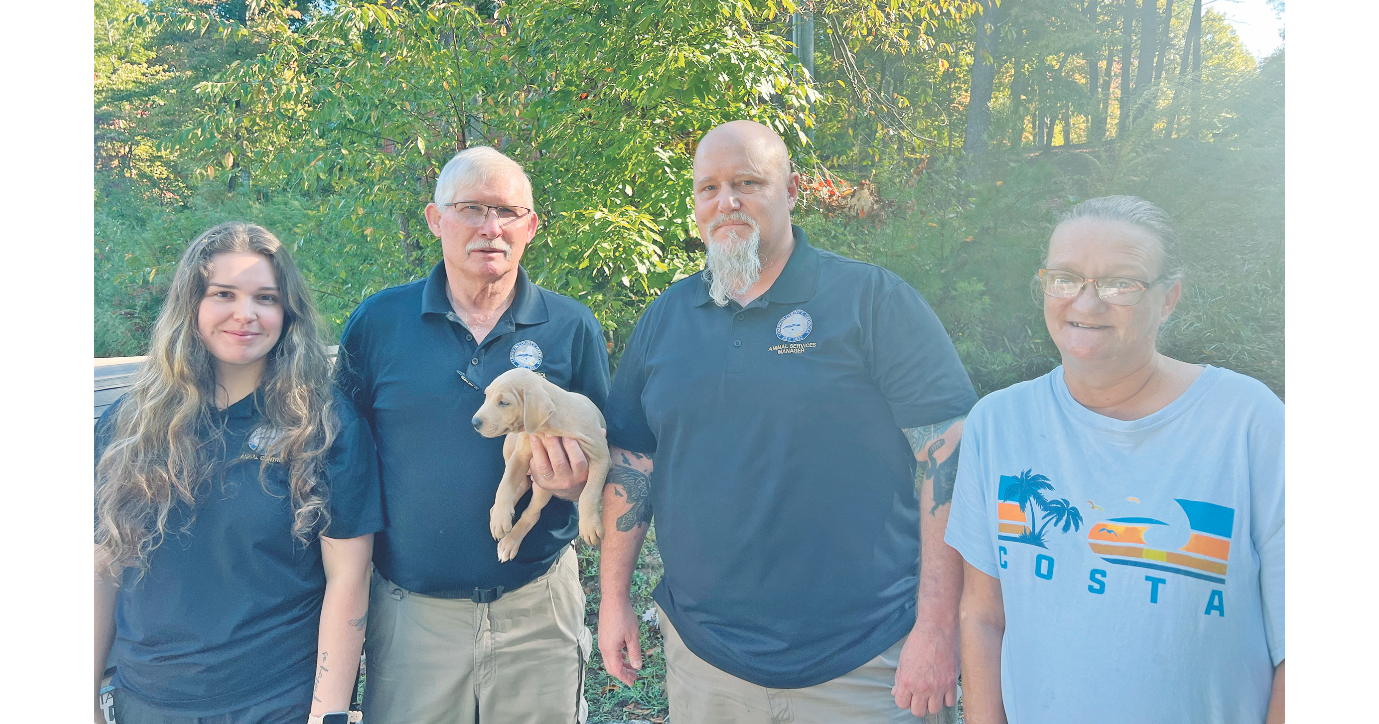
A chance meeting between Nugget Office Manager Chauna Utterback and another concerned citizen on River Flow Drive led to the rescue of five adorable puppies by Lumpkin County Animal Control last week.
The unexpected encounter also provided Animal Shelter Manager Wayne Marshall with a special opportunity to dispel some of the common misconceptions about his department, and educate the public on the critical role that Animal Control plays in public safety.
Marshall has overseen operations at the Red Oak Flats facility since 2018, about a year after the department absorbed Animal Control duties previously handled by the Sheriff’s Office.
“I started as an animal care technician and moved up. And then when Eddy [Harris] left the position, I became the Director,” Marshall said during a sit-down interview with The Nugget just days after the puppies’ rescue.
Marshall’s enthusiasm was evident in the stacks of computer-generated reports arranged neatly on his office desk.
“Adoption rates, case rates for the year, I’ve got it all for you,” he said eagerly. “Because I think it’s important that people understand.”
PUPPY LOVE
The story actually began on Thursday morning, when local resident Melissa Bouchez answered a doorbell ring at around 8:15.
Bouchez said a woman stood there holding two small puppies that she said had been wandering in the road. The woman reported that a third puppy had run into a nearby drainage pipe, while the mother ran away.
Bouchez was inspecting the scene when she saw Utterback cruising slowly through the neighborhood, searching for her step-daughter Elisabeth’s missing cat, Bella.
“I rolled down my window to tell her what I as doing. That’s when she told me there was a puppy in the drainage ditch,” Utterback said. “I parked my truck in the neighbor’s driveway and got down in the mud and saw her about 16 inches in, crying and sad.”
Bouchez had put out some cat food to try to lure the dog out of the drain pipe, but it wasn’t working. She said she was lucky to run into Utterback, who quickly dialed Animal Control.
Marshall was first on the scene, followed shortly thereafter by Animal Control Technicians Tony Ashe and Jeannie Knight.
“The dog was out within three minutes of them showing up,” Utterback said.
SAVING ANIMALS
In a subsequent interview, Marshall said Animal Control now utilizes “a lot of modern approaches.”
“We don’t just pick up animals and put the burden on the County. We investigate. My staff memorizes where animals are in the county, and that helps us keep animals out of the shelter when we can, by returning them to owners that are responsible,” he said.
Marshall said the owner of the eight puppies was not responsible, however, as staff had already had prior dealings with him. Upon visiting the owner, Animal Control discovered two more puppies, which were immediately surrendered.
But yet another call Friday morning led to the discovery of two additional puppies roaming the neighborhood, bringing the total currently under Animal Shelter care to five.
At least three other puppies from the litter were removed from the area by passers-by, bringing the total number of strays in the case up to eight.
“Through education and negotiation, our first goal is humane care. And then, code enforcement … He was cited and we will bring him before magistrate court to discuss future responsible animal ownership,” Marshall explained.
“We utilize that aspect of our job to compel them to do the right thing,” Marshall said.
He emphasized that not all strays are neglected animals, however. An ‘at large’ incident can also be an accident, corrected through education rather than citation.
PROACTIVE PROCESS
Even though the state mandates a three-day hold window for new animal intakes, Marshall said County policy is a five-day hold.
“It’s more reasonable to give an owner the chance to come forward. Again, not all stray animals are stray because of neglect,” he explained. “It also gives us that time to evaluate the animal’s temperament and diseases.”
Marshall said the only factors that could render a dog or cat “unadoptable” after the initial five-day hold period is the presence of a state-designated disease such as parvo, or if the animal demonstrates what is referred to as “real aggression.”
“And what I mean by that is something that is a danger to the public, not just ‘I’m afraid,’ he clarified.
Marshall said human cases of parvo are uncommon but the disease is highly fatal to dogs, and can wipe out whole canine populations if left unchecked.
“It can live in the dirt six months to a year,” he added.
Marshall said his facility is not licensed for life-sustaining parvo treatments, so the state mandates euthanization in those cases. Any dogs or cats under a year old are tested to protect the rest of the shelter population.
“We have to assume they’re unvaccinated,” he said of young animals.
Older dogs and cats are diagnosed by symptoms only.
“Usually a year old or older has built up natural immunities, and we don’t see as much in those,” he said.
In cases of real aggression, the procedure still calls for a five-day hold while the owner is sought out.
“After that point we run through a series of tests, both with animals and dogs … reaching for food, can I take a toy, things like that show us the level of reaction,” he said.
Marshall said there is “no doubt” when a dog must be euthanized for aggression.
“They are lunging. They are trying to hurt somebody, or they actually do,” he said.
SURPRISING STATISTICS
Marshall said there are a lot of misconceptions about local Animal Control, like the idea that they will not pick up cats, or the notion that rescued dogs are destined for doom.
“I have not euthanized for time and space in almost eight years. We are going into the eighth year,” Marshall said, meaning neither hold time nor facility capacity have caused a cat or dog to be put down during that period.
Marshall said the shelter’s year-to-date euthanasia rate sits at only 8.5 percent, well below the 10 percent threshold which allows private organizations to receive “no kill” status.
“91.5 [percent] leave here by transfer, adoption or owner reclaim,” he added.
Marshall also said he’s never had to euthanize anything besides a dog or cat.
“Department of Natural Resources [DNR] is in charge of free-ranging wildlife, not us,” he said.
In addition to dogs and cats, Animal Control does handle “rabies vector animals” that “have come in contact with human beings or with companion animals and possibly scratched or bit them.”
“Raccoons, foxes and bats are our primary rabies vector here,” he explained.
HOG WILD
Over the weekend, a Lumpkin resident said she had noticed a pig grazing on the side of Auraria Road for a couple of weeks.
On Friday she saw law enforcement observing the animal and assumed it would be taken in, only to later find the pig’s body laying beside the road.
“This made me sad and mad,” she wrote. “Why was it like this?”
Local social media users echoed her concerns.
Marshall said he was aware of sightings of the hog, and that it was wild and not domestic, but was unaware that it had reportedly been neutralized.
In a subsequent phone call, Sheriff Stacy Jarrard confirmed that the pig was, in fact, wild and was venturing in and out of the roadway.
After an officer witnessed a near-accident involving the pig and some motorcycles, he reportedly consulted DNR before shooting the animal.
Jarrard said the pig was left for the Lumpkin County Road Department to pick up as protocol dictates.
Marshall said that if there’s a bear complaint, a fairly common scenario in North Georgia, that call goes to DNR as well.
“But if you have a raccoon being aggressive in your house and there’s not enough DNR to come help you, we come out and help you with that because of the rabies vector,” he added.
EDUCATION FIRST
Marshall said public education, peer communication and resource-sharing have become serious areas of focus for Animal Control in recent years.
“That’s how we keep as many animals from coming to the shelter as possible.”
Through educating animal owners on best practices such as spaying or neutering and providing struggling pet owners with discounted services and, if needed, shelter contacts, Marshall said he has seen the numbers shift.
Year-over-year numbers indicate that guardian surrenders and animal euthanizations are down significantly, while successful adoptions are ticking up.
“We don’t wait for there to be a problem,” Marshall insisted. “That was a bad practice back in the day: wait until you’re at capacity. No. My staff is on the phone every day, whether we have animals to ship or not, saying ‘How are y’all doing? How have you been?’ We have real relationships with these people,” he said, referring to other animal-friendly organizations.
Marshall was quick to admit that his good intentions for the animals won’t always translate into the correct decision being made.
“I’m a human. But what it does mean is that if we fight that good fight, we can make that difference,” he said confidently.
Anyone interested in adopting one of the puppies mentioned in this article can contact the Animal Shelter at 706-867-7297 for further information.