
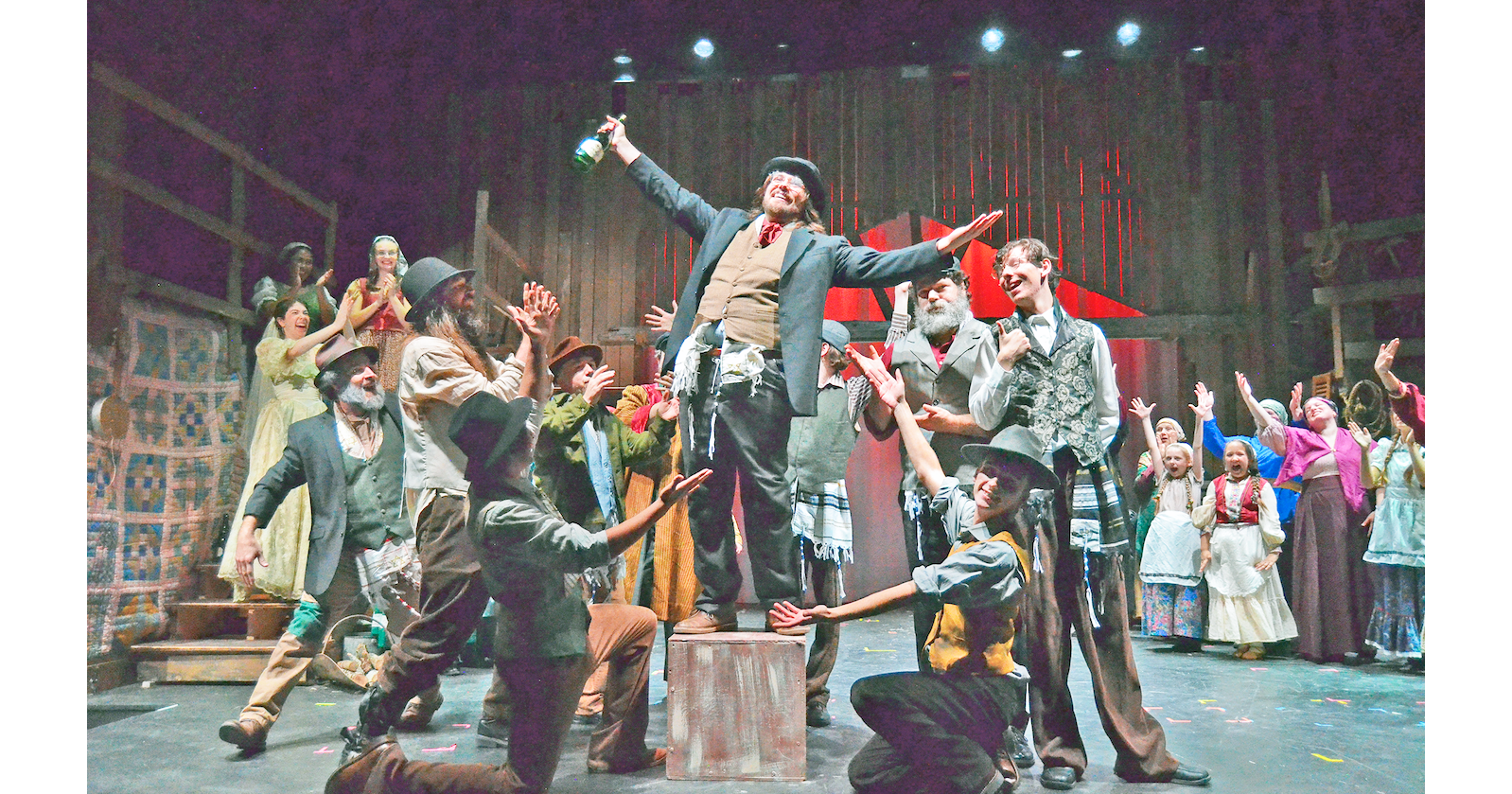
By David Zunker / The Nugget ----------- Sometimes we take the magic of theater and its power to transform reality for granted.
Years ago, after attending a particularly stellar performance of A Chorus Line, that same thing happened to me—I stepped out into the chill of a Minneapolis evening and expected to be in the glitz and hubbub of Times Square. I had been transported.
For The Holly’s production of Fiddler on the Roof, which opened last weekend, and continues with performances this weekend and next, your experience may be the same.
Co-directors Stephanie Garrett and Bebe McLarrin were relentless in their pursuit of authenticity in this production. Even so far as seeking guidance early on for the entire cast from Rabbi Elizabeth Breit, who pointed out that humor is a fundamental part of the Jewish identity and culture. Notwithstanding the hardships of the Jewish culture, we are reminded by Yente (played brilliantly by Holly veteran Janice Baskin) that “(the Jews) suffer,” there is an underlying playfulness throughout the production, despite the obvious enormous hardship.
I would strongly encourage everyone—first, of course, to attend this production (it is indeed joyous)—but also to pay close attention to the details of the set design, the music, the character interaction and costume design.
No one has attended to the details more than Drew Ferguson, not only in the lead role, but also as the set designer for Fiddler. As the downtrodden Tevye, Ferguson owns the stage from his initial appearance, lugging his iconic milk jug, to his “on the one hand/on the other hand” ponderings of life’s impossible decisions. It seems his hands and arms are always in the air in a “whatevah” shrug. His is also an incredibly demanding physical portrayal, which is not unusual for Ferguson, who has been known for demanding much from himself in various Holly roles. He has also been known for his inspired improvisation, a blessing and a curse for director Garrett, Ferguson’s older sibling.
Asked what it was like to direct her younger brother in the lead role, Garrett smiled a wry smile and suggested it had its moments—“he doesn’t listen to me,” she said. She said it with obvious love and admiration.
Yes, there is the outstanding singing and dancing by a captivating cast and ensemble. For Broadway fans, the tunes are familiar. Tradition, Matchmaker, If I Were a Rich Man, and Sunrise Sunset all echo the message of hope above hardship. All are enjoyable and passionately performed.
But look beyond the singing and dancing when you can and focus on the set pieces and the set design overall. It is, as is the musical itself, magical.
In the Tevye role, Ferguson is robust and wildly entertaining, but as set designer he has brought a touch of his own family’s “Tradition.” to the stage in the form of a subtle but authentic barnwood backdrop, and he even conjured a wonderful reproduction milk wagon from donated pieces of a rustic wagon. The wagon is a beast and is probably as heavy as it looks.
Ferguson (and Garrett’s) great grandmother’s favorite sewing machine and a few of her quilts even make an appearance. It’s all part of what Ferguson calls “inheriting customs, objects, stories and traditions”—real pieces added to the production that contribute to the play’s attendees being able to “slow down for a moment and remember what matters.”
For inspired costume design, credit Lara Potter, who also plays Tevye’s wife, Golde. Authenticity in fabrics and costume design play a central role in making this play feel just right. Potter has gone far above and way beyond honoring tradition and replicating what a Jewish family in the early 1900s would have had to work with. The repurposing of threads and scraps produces a colorful and random mixes of fabrics that works. In her program notes Potter also references a “joyful” result.
But nothing is more joyful in this play than the music, which serves as the backdrop for the wedding scene, the bottle dance (no, there was no Velcro on top of those hats), and the dream sequence, with inspired Edward Scissorhands fingers.
Music direction is by Kate McElliott, a daughter in the Holly’s family of Quigleys, who points out that this production remarkably melds true family members in a cast that numbers in the mid-30s.
Tevye and Golde’s three daughters—Ashley Arroyo as Hodel; Wynn McElliott, as Tzeitzel; and Senia Mae Zajac, as Chava (who all look and sound like real sisters) have perhaps the most powerful voices and project a remarkably confident stage presence.
At its heart, the message of Fiddler on the Roof contrasts tradition with change at a time of challenge. This production has its heartfelt and sad moments, but at other times (and most of the time) you will laugh and perhaps even hum along. It is inspiring.
The message is delivered through the music, the dance, the innovation and the passion of this talented cast and crew.
You may be so taken in by this production’s transformation into the tiny village of Anatevka, that you too may walk into the Dahlonega evening or afternoon wondering how you ended up somewhere other than where you are.
Fiddler on the Roof continues its run this Friday and next with performances on Friday and Saturday at 7:30 p.m. and Sundays at 2 p.m.
LOCAL MUSIC TEACHER TAKES ON NEW PERSONA IN STARRING ROLE
If you are one of those who hastily scours a playbill just before the start of a theater production, looking for people you know in the cast so you can watch for them when they appear onstage, you might be surprised, when The Holly Theater’s Fiddler on the Roof starts, not to be able to find your friend Ann Whitley Singleton.
She’s there in the program, cast (appropriately enough for those who know Ann as a long-time Pick & Bow teacher and performer at Bear on the Square), as The Fiddler.
But when the Fiddler appears in Act I and begins that familiar mournful tune, where’s Ann? Instead of the Ann we know, there’s a smallish man, with shortish hair, a greenish hat, and the scruffiest of mustaches.
Just listen to the fiddle. Yes, that’s Ann.
This is not the first time Ann has appeared in a Holly production. She was in Radio Gals in 2012—showed up to be in the band, she says, and was cast as the lead. She’s always had theater aspirations. When she was a little girl, listening to Broadway musicals on her record player, she thought she was going to be a Broadway star. Broadway didn’t quite happen, but being in a musical was always on her bucket list. And here we are.
She’s always taught music, dating to when she and husband Doug lived in Decatur, and worked for the city schools there. She has been a performer at Bear on the Square since its beginnings; she is on the worship team for Creekstone Church (Doug plays standup bass); and she’s part of a small group of Old Time Music aficionados who play regularly at the Vickery House, home of the UNG Appalachian Studies program. So, she is familiar to those who love fiddle music in all its forms.
She doesn’t consider herself a violinist, unlike Isaac Stern, the classically trained symphony violinist who was the Fiddler in the movie. She’s a fiddler, she says, and the difference is in the bowing.
The mustache was her idea when she was cast as the Fiddler. She always saw the character as a man, with a mysterious connection to Tevye. You see that in the times they are together onstage. There’s a moment, a pause and it’s clear, for Tevye, the Fiddler is a little bit magical.
Magical indeed.