
The parishioners of St. Peter Lutheran Church in Dahlonega have a lot to be proud of.
That’s because the congregation was able to pull together and, combining their own homegrown talents and skills, open an impressive new 7,000 square-foot Ministry Center earlier this year.
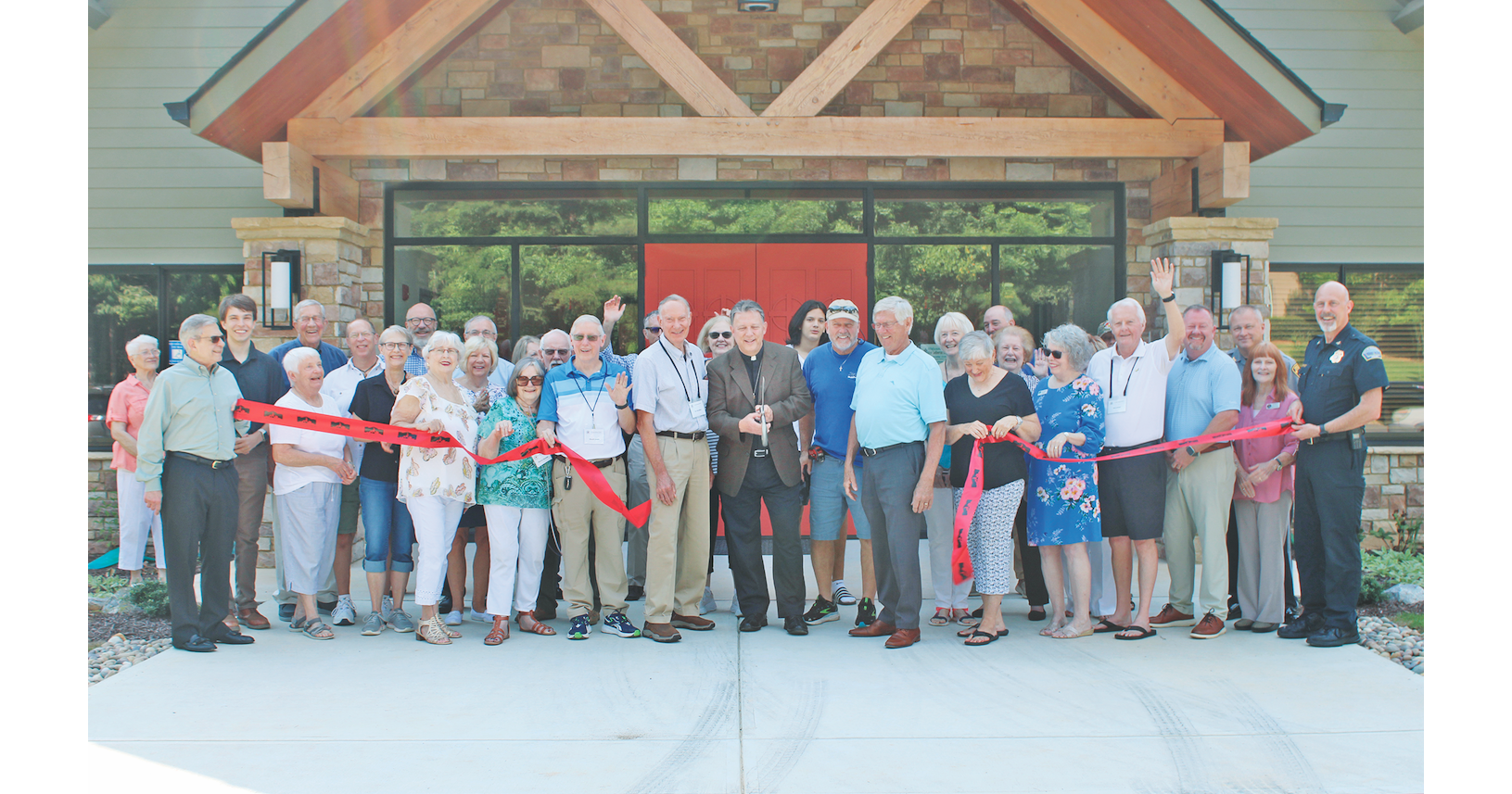
The new Ministry Center received its spiritual dedication on February 23, followed by a secular ribbon-cutting ceremony with the Chamber of Commerce on June 25.
Building Committee Chair Frederick Weidenmann estimates that, in addition to a three-year fundraising campaign, a dedicated commitment of volunteer labor for everything from carpeting and kitchen cabinetry to reupholstery and landscaping saved the church approximately $225,000 in up-front construction costs.
Rev. Charles J. Kanefke, known to many in his congregation as “Pastor K,” told The Nugget that the church purchased the property located at 3460 South Chestatee Street back in 2021, at a cost of $227,000.
“The building itself was another $1.6 million, and out of that we have a mortgage of about $340,000,” he said.
According to Wiedenmann, it was retired Pastor Gerhard Michaels who originally had the idea for a new Ministry Center to replace the church’s much smaller 2,000 square foot home.
Michael wanted the new sanctuary space to utilize moveable chairs, rather than pews, to create a more versatile worship space.
“Then we were able to get additional money to build on this Fellowship Hall, so we have two spaces now for the community to use,” Wiedenmann said.
PITCHING IN
Parishioner Van Bareither contributed virtually all of the outdoor landscaping on the church grounds.
When asked if he had a prior background in professional landscaping, Bareither responded by saying both “Yes and no.”
“My dad was a landscape architect, and I worked with him for about eight summers before I went to college,” he said.
Bareither went on to explain the history of the project, which was complicated slightly by its location near the entrance to the River Knoll Community.
“There’s a little bit more history to it: before we ever bought the property, this section of property, about two-and-a-half acres, was part of a Planned Unit Development (PUD). This was supposed to be a commercial property that the people in River Knoll could walk over to—maybe with a coffee shop, a flower shop, different things that could serve them,” he said, referring to a popular trend of residential developments with an adjoining commercial element.
Bareither said the key to making the unusual arrangement work was creating an open line of communication with River Knoll’s residents before construction ever began.
“We started working with them early on to let them know what we were thinking, and they were glad for us to come in rather than an alternative, because we were a known commodity,” he added.
Bareither said a big advantage for the church was the property’s location inside the city limits.
“This was part of the City, so it was basically ready to move in. We didn’t have to do too much grading,” he added.
But the assets that the church relied on most were the skill sets of its individual members—members like Scott Richardson, who designed and installed the church sound system, Catherine Szilagyi, who donated a baby grand piano, and Linda Larson, who donated hours of her time to re-upholster approximately 100 individual chairs.
COMMUNITY ENGAGEMENT
A key goal of the new Ministry Center is to promote interaction and involvement with the community at large.
The church’s new Fellowship Hall is already assisting in this mission. With it’s many large windows and ample natural light, the room is a great place to host activities.
“We have Bible class in here on Sunday morning before the service, but during Lent and Advent we have Wednesday night services where we have a meal before the service, and so this is where we have our potluck meals,” explained Bareither.
In addition to official church uses, the Fellowship Hall also serves as an impromptu classroom for the church’s free after-school tutoring program.
“We cater to Cottrell Elementary School students: third, fourth and fifth graders. So we meet here on Tuesdays after school from 3:00 to 5:30. We give them a meal after we do the tutoring for math, reading and writing,” he added.
Bareither said he would personally be heading to Cottrell when school starts back in August to make an appeal on behalf of the program.
“We’re having fewer students than we’d like to have, so I will probably go make a pitch at their PTA meeting right at the beginning of school,” he indicated.
Elementary teachers in those three grades can recommend students that are having some difficulty in any one of the three subject areas.
If parents approve, those children are provided transportation via DahloneGo directly from school to the church for one-on-one tutoring.
“If they haven’t gotten up to speed in reading by third grade, then they just keep falling farther and farther and farther behind, so we’re trying to help with that,” Bareither said.
Other planned uses of the Fellowship Hall include hosting the Dahlonega-Lumpkin County Ministerial Association, of which Kanefke is currently President, as well as serving as one of four host churches for CHP’s annual Tomato Sandwich Supper benefit on July 17.
“We’ve got a really good relationship with a lot of the churches in town. They’ve been really supportive of us, and it’s a real blessing to have all these other pastors and churches that we partner with,” Kanefke said.
There is even talk of possibly providing a future meeting space for a local Boy Scout troop.
“We’re just trying to be the church in your neighborhood where we support what’s going on,” Kanefke added.
PLANNED TO PERFECTION
Bareither noted that Wiedenmann was the perfect person to oversee the ambitious project.
“He was certified as an architect in Florida, but he worked for the government, so he never got his license here in Georgia. He drew up the basic plans knowing what we needed … we had to have another architect put the drawings onto CAD (Computer Aided Design software) for construction purposes and approval by the City,” Bariether said.
Wiedenmann said part of the key to the project’s success was meeting with the River Knoll Homeowners’ Association early on in the process.
“We worked really closely with them. We went to them before we did the initial design,” he said. “We’ve invited the Homeowners’ Association to use this as a meeting place for their meetings. We’re open to other community groups to utilize our space.”
Wiedenmann said the original plan for the PUD was to add a strip mall, with the back of the stores facing the highway.
“The Planned Unit Development said that we had to blend in with the residential. So there were some restrictions: we couldn’t have flat roofs and the exterior colors and stone had to match River Knoll,” he said.
Wiedenmann described the new Ministry Center as “a plain, general building” overall.
However, the deceptively simple sanctuary design is punctuated by a one-and-a-half-ton solid rock altar with an ornate stained glass window in the shape of a cross rising on the wall above it.
“It’s faceted glass, so it’s about an inch thick and it’s put into a matrix. You can see the seven different panels,” said Kanefke.
“We have it lit at night, too. If you’re ever driving by, you can see the cross lit from the outside,” added Bareither.
In addition to his architectural background, Wiedenmann, the son of a Lutheran pastor, said his lifelong exposure to the church also helped prepare him to design a functional, versatile worship space.
“I grew up in the church all my life, and was taught Lutheran since the day I was baptized. I pretty well know what happens inside the church and what spaces are needed,” he said.
Wiedenmann reiterated that the massive project was a team effort, from start to finish.
“Even though we’re up in age, we worked really hard and we’re really blessed. We look forward to a lot of families and children using our facility going forward,” he concluded.