
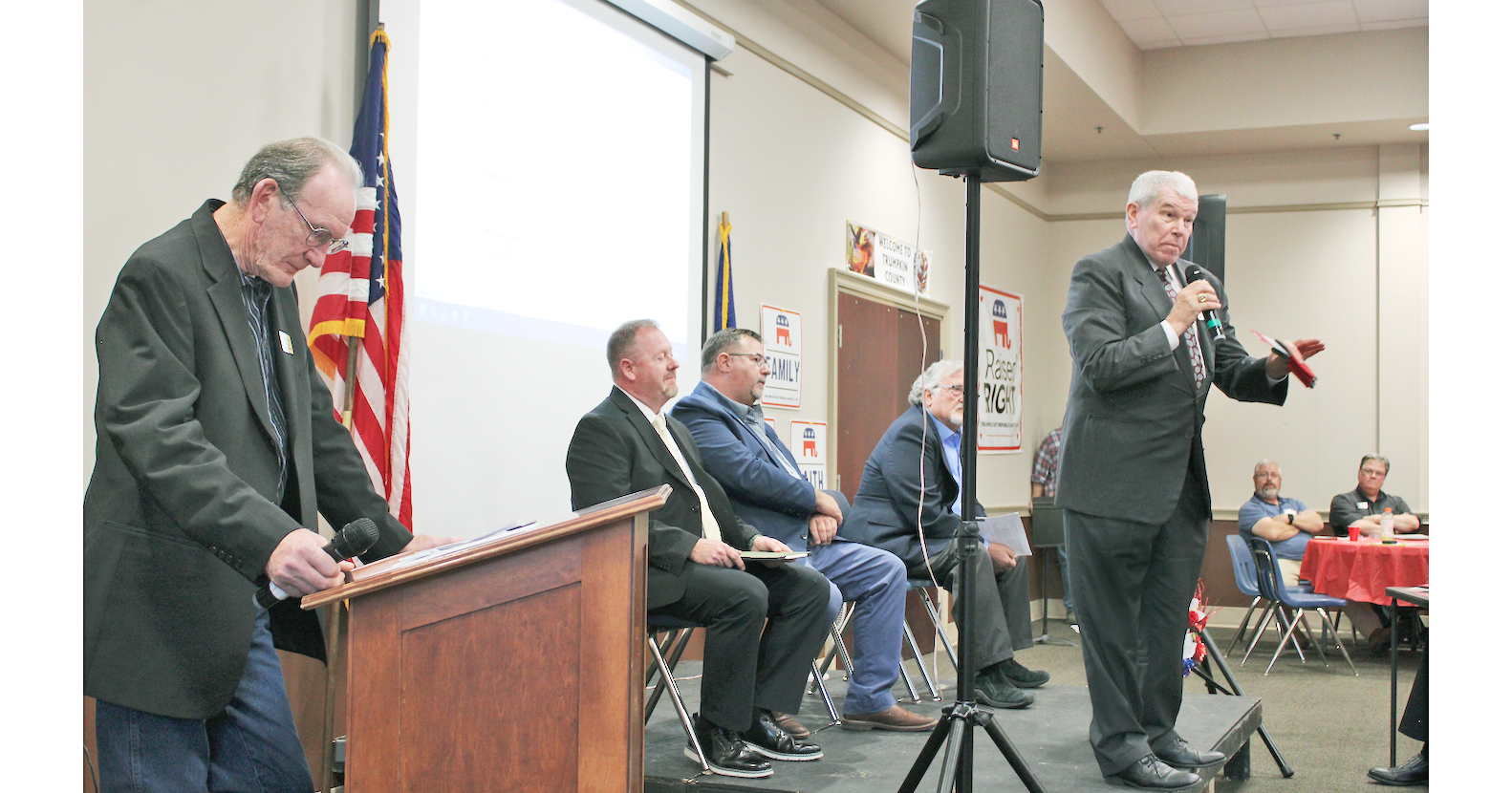
Thursday night ushered in the first fireworks of the election season, as the Lumpkin County Republican Party hosted a non-partisan candidate forum inside the local Parks & Rec community center.
The highly-anticipated event featured 19 different candidates vying for various local and state offices, and was standing-room only. Interested onlookers spilled out from the open doors on both sides of the room, into the main hallway and onto the grass outside the building.
Electric fans positioned strategically throughout the room did their best to keep fresh air circulating throughout the three-hour event, which featured candidates from two Board of Education races, a Superior Court judge race, a state Senate race, a state House race and two Board of Commissioners races: District 3 and County Chair.
The latter two contests are Special Elections to fill the remainder of unexpired terms on the Board of Commissioners, and therefore will be decided on May 19, assuming there is not a runoff.
The evening focused on the theme of growth, and whether voters prefer an extensive résumé of public service or the fresh approach of a political outsider.
HEADLINE MATCHUP
The last group to speak was easily the most anticipated, and that was the candidates vying for board chair: former District 3 Commissioner Rhett Stringer and former Lumpkin County Republican Chair Katherine James.
Stringer thanked the crowd for sticking around before quickly pivoting to the campaign’s defining issue.
“There’s been a lot of talk tonight about growth, from the state level all the way down to the local level. Everybody in the room tonight who’s gotten up on the stage has talked about what they’re going to do: I can tell you what I’ve done,” he said.
Stringer told the crowd that Lumpkin is the “slowest-growing” county in the region, citing residential permit starts that lag well behind Union County, White County, Dawson County and Hall County.
“Obviously there is some room for improvement, but I think what we’re doing is working,” Stringer continued. “We have a sewer ordinance in place to help moderate the residential growth, even on the high density side. There’s a cap there at 60 percent. We’ve got a major investment there, and we want to protect that investment from residential. We see that happening to our south: They make a big investment in infrastructure and it’s followed by residential. I don’t think anybody here wants to see that,” he added.
Stringer argued that his 11 years of prior experience on the Board of Commissioners is a valuable asset.
“I can hit the ground running on day one. I require no training or anything like that. I have relationships with the DOT, our state legislators, the City,” Stringer said.
He argued that matters even more since the winner will only get an abbreviated term.
“I want everyone to be aware that this is not a four-year term that we’re running for. This is a Special Election to fill the void from the Chairman’s resignation, so we really have less than two years to be able to make this all work. So by the time someone new figures out how everything works, no offense to their educational background or anything at all, it’s going to be time to run again,” Stringer said.
When it was James’ turn to speak, she said her motivation for seeking the chair is “to preserve the character of this precious county and prevent it from being overwhelmed by poorly-planned growth.”
“It’s about supporting our local businesses, and yes, it’s about working with the City so we can fill vacant buildings before the college scoops them up,” she said to spontaneous applause from the audience.
James said she does not oppose growth, but rather opposes “out-of-date practices and philosophies” that open up the County to lawsuits.
She cited a Special Land Use Agreement with local RV resort Iron Mountain Park as being a particular example of failed County oversight.
“Those neighbors still plead with the commissioners to sleep in their homes at night after eight years. There is nothing that the commission has done that has worked to stop it, but yet Dawson County just won a settlement against Iron Mountain Park to shut it down … Just last year, the best our commission could do was to settle to fine Iron Mountain Park $250 and extend operating hours, against the neighbors’ wishes. So Dawsonville finds a way to win, and our best is to make the situation worse for the neighbors,” James said.
Stringer and James fielded a number of questions. The first was why Lumpkin County does not have impact fees.
James said impact fees are “an option that we need to look at,” calling them an alternative method to offset the local infrastructure cost of development without raising taxes.
But Stringer disagreed.
“Yes, they give the County more money, and the City and the school board. But it’s a pass-along … I’m personally not in favor of impact fees: You pay property taxes for a reason,” he replied.
Next Stringer was asked how many times, if any, he voted ‘no’ against Chris Dockery while on the board.
Stringer noted that the Chair typically does not vote, so he couldn’t recall an exact number. He said he has had plenty of disagreements with Dockery in the past, but does not “take that into the public anymore.”
Both candidates were asked to provide three qualifications that distinguish themselves from their competitor.
Stringer cited his experience on the board, his close relationship with the Georgia Department of Transportation and his involvement in the community as a successful business owner.
James, meanwhile, touted her unique background in architecture, business and technology, proven leadership skills and “fresh ideas,” including advocating for a new representative body for 48 counties that have ties to the University System of Georgia.
At one point James was asked if she was running for Chair simply to stop Iron Mountain.
“I was told by the former Commission Chair that there was nothing more that could be done, that those decisions had been made. I took him at his word. So today guys, sorry to tell you, today we have to move on. Everything has been done, according to the Commission Chair,” she replied.
But Stringer questioned how James’ past vocal stance against the RV park would “play out if that comes back before the board.”
Then Stringer was asked to explain why he voted to allow hotel/motel development in Restricted Development areas.
“I’m going to make an assumption that that’s in reference to the Montaluce development,” Stringer replied. “The gentleman out there already has an active winery. They produce wine there, they have a very large wedding venue. Again, traffic is going to come up. From what I understand, the gentleman is looking to build a hotel there and have some more on-site housing. That was the request, and that was the reason for that code change.”
He pivoted to a number of “positive” changes during his tenure on the board, chief among them the creation of the Gateway Corridor Overly District.
He said the board’s 10-12 year long-term plan to “capture” growth along the 400 Corridor through the deliberate placement of necessary infrastructure like water and sewer lines is “finally coming to fruition” with the expected opening later this year of the new Cane Creek Water Treatment Plant.
He cited the imminent start of DOT improvements to the Hwy. 60/Hwy. 400 intersection as good news on the traffic front, but James said the two left turn lanes being added will force twice as many cars onto Hwy. 60, only to winnow traffic back down to a single lane headed into town.
“The Georgia DOT just told me that they are not planning to widen 60, not even considering it, until 2051,” James reported.
The final question for both candidates revolved around their view of private property rights.
Stringer said the board has worked to improve the Code of Ordinances and “cut way down on the variances,” although he acknowledged there is still plenty of work to be done, noting that people always value their own property rights above those of others.
James said she agrees with the philosophy of private property, but said “incompatible uses” can unfairly taint neighboring property values.
“The way it is today, saying that [the ordinances are] not perfect is way far off-base: They need to be fixed,” she declared.
COMMISSIONER RACE
Candidates for District 3 County Commissioner, Nathan Davis, Anita Anderson Spangler and Randall Chambers, were also on hand.
Davis touted himself as a “business improvement and turnaround specialist” who would reduce property taxes and review the County’s Code, line by line.
Spangler said the overvaluation of property taxes is one of her central issues.
“I was excited to hear the state was voting to do away with property taxes on homesteads, because we’re practically paying rent on land that we own. And I don’t know about y’all, but I’m tired of being treated like a pocketbook for the County, the state and the nation with little to none of the representation that our forefathers promised us,” she said.
Chambers presented himself as “an honest, hard-working man who stands behind his word.”
He said the only two campaign promises he would make are to do his job to the best of his ability and make himself available to anyone who needs help.
All three candidates acknowledged the reality of growth, but agreed that it should be intelligently guided. Spangler described the Code of Ordinances as “the key to everything.”
“It is the key to allowing us to do what we want to do with our own land, while also slowing down the land developers and everything else that wants to come into the County,” she said.
STATE CONTESTS
As for the state races, Senate District 51 candidate Philip Milam was out sick, so his Campaign Manager Richie Stone spoke on his behalf. Opponent Gary St. Lawrence attended, but Will Wade and Steve Shaw did not.
Stone said Milam “completely supports eliminating the state income tax and he supports a cap on property taxes,” while St. Lawrence pledged to focus on obtaining what he can from the General Assembly for Lumpkin and other counties in the district.
St. Lawrence said he would recommend using money from the state budget surplus to fund local initiatives.
All four candidates for state House District 9 were on hand, including Chris Dockery, Wayne Rowan, Roger Smith and Doug Sherrill.
Dockery said voters should look for the candidate who has the most leadership experience.
Rowan suggested that removing state maximums on local impact fees could help alleviate the concerns he is hearing about growth. He said he also wants to freeze the increase in property values for tax purposes.
“I’d rather make the commissioners actually have to raise your millage rate,” Rowan said.
Smith said hard work should pay off in America, and that promise is being broken in north Georgia.
“One fifth of adults in this County don’t have health insurance. That number is rising. And that is not bad luck. That’s a decision made by people who answer to folks who paid for their campaign,” he declared.
Smith also pledged to oppose the logging industry in the region, adding “Stumps don’t bring tourists.”
Sherrill, meanwhile, warned that taxes are getting out of control and growth is outpacing local infrastructure.
He called for improving utility and transportation infrastructure, overhauling the school system’s QBE formula and protecting children from crime.
When asked about his stance on eliminating property tax in the state, Dockery said it’s something “that we need to take a big look at.” He suggested offsetting the property tax with a universal sales tax “so there are more people that are helping provide the funding for local government instead of just property owners.”
“That’s what I intend to fight for in Atlanta,” Dockery said.
Full video of the entire event is available in two parts on YouTube; Search “Lumpkin County Republican Party Candidate Forum April 2 2026.”