
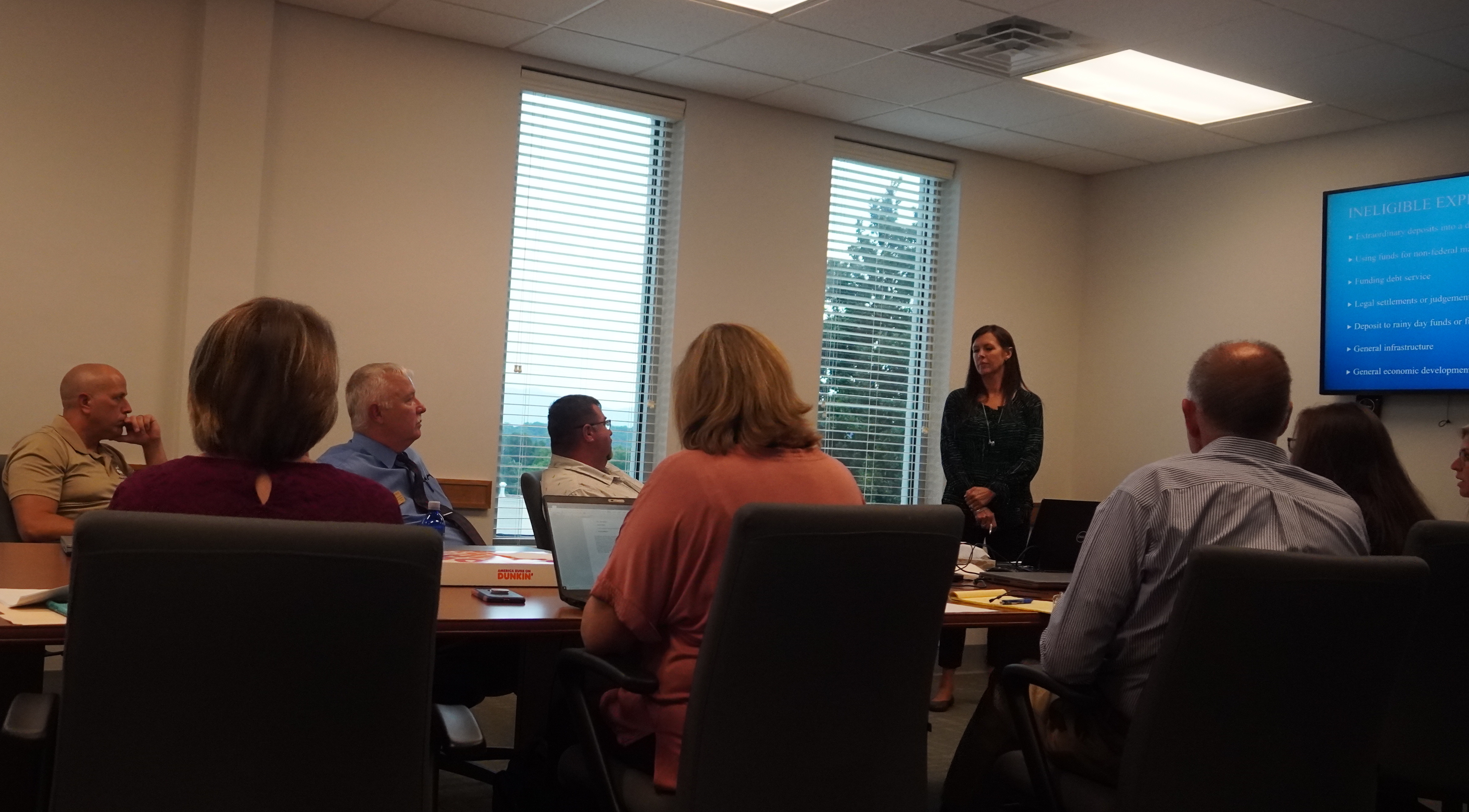
A debate on how to best spend the $6.5 million of American Rescue Plan (ARP) funds allocated to Lumpkin County turned heated during Wednesday’s Special Called Meeting as commissioners argued about which eligible uses best serve the community.
The American Rescue Plan was designed around providing “direct relief to the American people” and was signed into law by President Biden on March 11. While the first impact of the plan came via the $1,400 stimulus check to households received earlier this year, the federal government allocated $61.5 billion in direct federal aid to county governments. Of that, Lumpkin County was allocated $6,528,348 and has already received half of that allotment. The remainder is scheduled to be received in 2022.
Lumpkin County Financial Director Abby Branan presented the possibilities of the plan to the board and other county staff. Branan noted how vague the ARP is written when it comes to potential uses of the funds by county governments. This lack of guidance from the Federal government made the board uneasy.
“If it can’t be defined, I’m not comfortable moving forward with it,” said Commissioner Chairman Chris Dockery. “...At the end of the day, somebody is going to go to jail and it’s not going to be me.”
The plan lists the different eligible uses of the funds including to: support public health response, address negative economic impact, premium pay for essential workers, payroll expenses for public health and public safety employees, replace public sector revenue loss and water, sewer and broadband infrastructure.
According to the plan, county governments have until December 24, 2024 to obligate the funds and even longer to spend them, as the funds must be expended with all work performed and completed by December 31, 2026.
With the amount of time allowed, Dockery insisted the board distinguish between immediate needs and long term needs and just go forward with the immediate needs in the short term.
“There’s no benefit to the community in the money just sitting there, but then again, I think the benefit to this board is to learn how the funds can and can’t be distributed,” he said.
Those short term needs were determined to be water and sewer infrastructure work at Rivertrace Subdivision and a potential bonus paid out to essential county employees.
The tense exchange between commissioners came when debating giving an employee bonus to essential county employees as a use of part of the ARP funds classified under “premium pay for essential workers."
According to the presentation, the plan defines essential work as “work involving regular in-person interaction or regular physical handling of items that were also handled by others” and that any essential county employee is eligible. Commissioners Jeff Moran and Bobby Mayfield first showed interest in the possibility of using funds for essential workers.
““That’s one of the ones that I’m interested in,” Mayfield said. “I’m always looking to put dollars in the pockets of our hardworking county employees. During the COVID thing, they put their tails on the line and I’m not just talking about our first responders that were out there dealing with the bad stuff. Even the day-to-day workers dealing with the public in general were exposed to that stuff the entire time. They took the risk and did a fantastic job and I think there ought to be some kind of commemoration for that.”
Dockery quickly made it clear he wasn’t a fan of the idea.
“We had a statistic on that ACCG sent forward and I think out of 159 counties, there were less than 50 that elected to do that for their employees. Again, I think it’s a slippery slope,” he said. “I mean if you look at what was given to them as tax credit, child credit, $3,000 here, $8,000 there. I just don’t think it’s sustainable. I don’t think that you have anything to show as a return from your investment. I think we did a very good job taking care of our employees during COVID and I think that the fact that we’re considering the implementation of a salary study. It’s kind of like if you join the army, you expect to get shot at, at some point.”
That’s where the frustration began amongst the board.
“You said to throw out ideas. That’s an idea,” Moran said. “There’s other counties that have used it and I do know that there’s some frustration with the merit thing going away and the implementation of the pay study that would definitely ease the fight of the merit pay going away with some sort of stipend toward essential workers or something.”
Mayfield then added that as employees of the school system, he and Moran received a similar bonus for being essential school employees through a different funding source that similarly appropriated funds to the system.
“I don’t even know what that source was, but through the school system we all got a thousand dollars,” he said.
After a little over 10 minutes of discussion on the other eligible uses, the idea was brought up again by Dockery.
“If you gave a one percent bonus to employees it would cost $140,000,” he said. “If you gave two percent it would be $275,000. If you gave three percent it would be $410,000.”
Mayfield suggested a one-time bonus similar to what the school system provided.
“I was thinking something much less complicated, just a flat dollar amount to every employee, a one-time bonus,” he said.
A tense exchange followed in which Dockery sarcastically suggested that Mayfield wanted to give $350,000 to each and every Lumpkin County employee. He added that he might as well give the relief funds to the part-time employees and their children as well.
“Everybody. Shoot. Let’s give it to the kids too,” said Dockery.
Mayfield appeared to be fed up with Dockery’s tone.
“Well if you want to be a smart ass about it, I guess we can give it to the kids,” he said.
Conversation came to a halt soon after this. Mayfield later apologized to the group for his language.
The board meets for its regular monthly meeting next Tuesday, August 17. At the moment, only the two water and sewer infrastructure items are on the meeting’s agenda, County Manager Alan Ours explained in a series of emails to The Nugget.
“On the agenda for next Tuesday are two of the projects,” Ours said when asked about the short term projects identified in the meeting. “If the Board decided to approve additional items it would need to be added to the agenda...The issue of an employee pay supplement would have to be approved by the Board.”