
The University of North Georgia recently hosted, for the third consecutive year, their famous Bayeux Tapestry Replica, the only full-size replica of its kind in the United States. UNG students and members of the general public alike were welcomed to the upper floor of the university’s Convocation Center this month to witness the exhibit. The original eleventh-century tapestry, which documents the Battle of Hastings in 1066, is still displayed in the town of Bayeux, in northern France.
The replica version donated to UNG was commissioned by Judge Edd Wheeler and hand-painted by artist Margaret Reville in 1987.
The main differences between the two is that the original “tapestry” was actually a work of embroidery in nine sections, while the replica only consists of three sections and was painted on canvas.
The Nugget had an opportunity to view the awe-inspiring art installation during a private reception on September 18, which was hosted by UNG Art History professor Dr. Ana Pozzi Harris and Director of Special Programs Dr. Chris Jespersen.
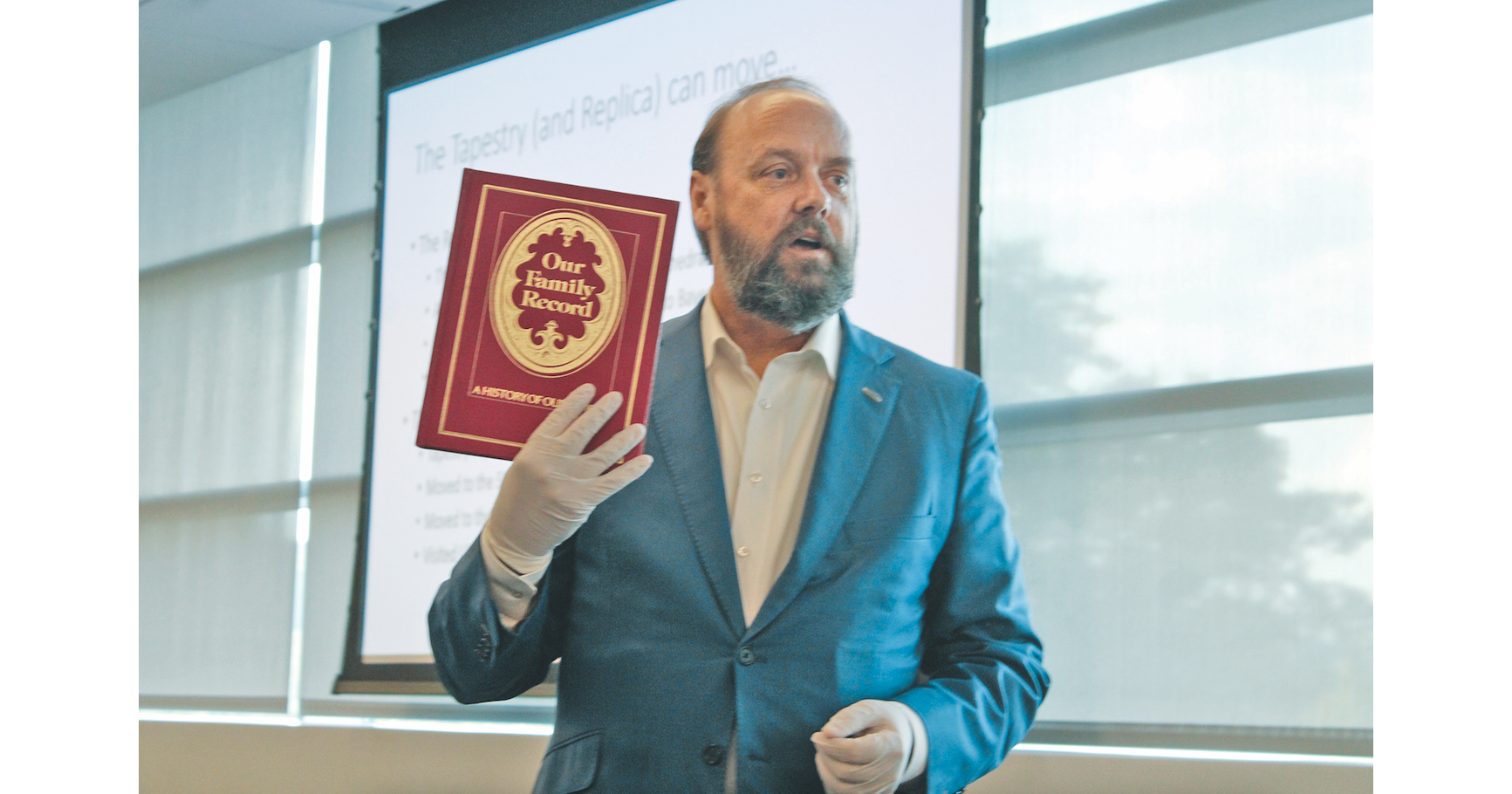
Also in attendance was guest speaker Dr. Andrew Leavitt, Chancellor Emeritus at the University of Wisconsin-Oshkosh, who provided both color and context for guests of the annual exhibit.
TAPESTRY TOUR
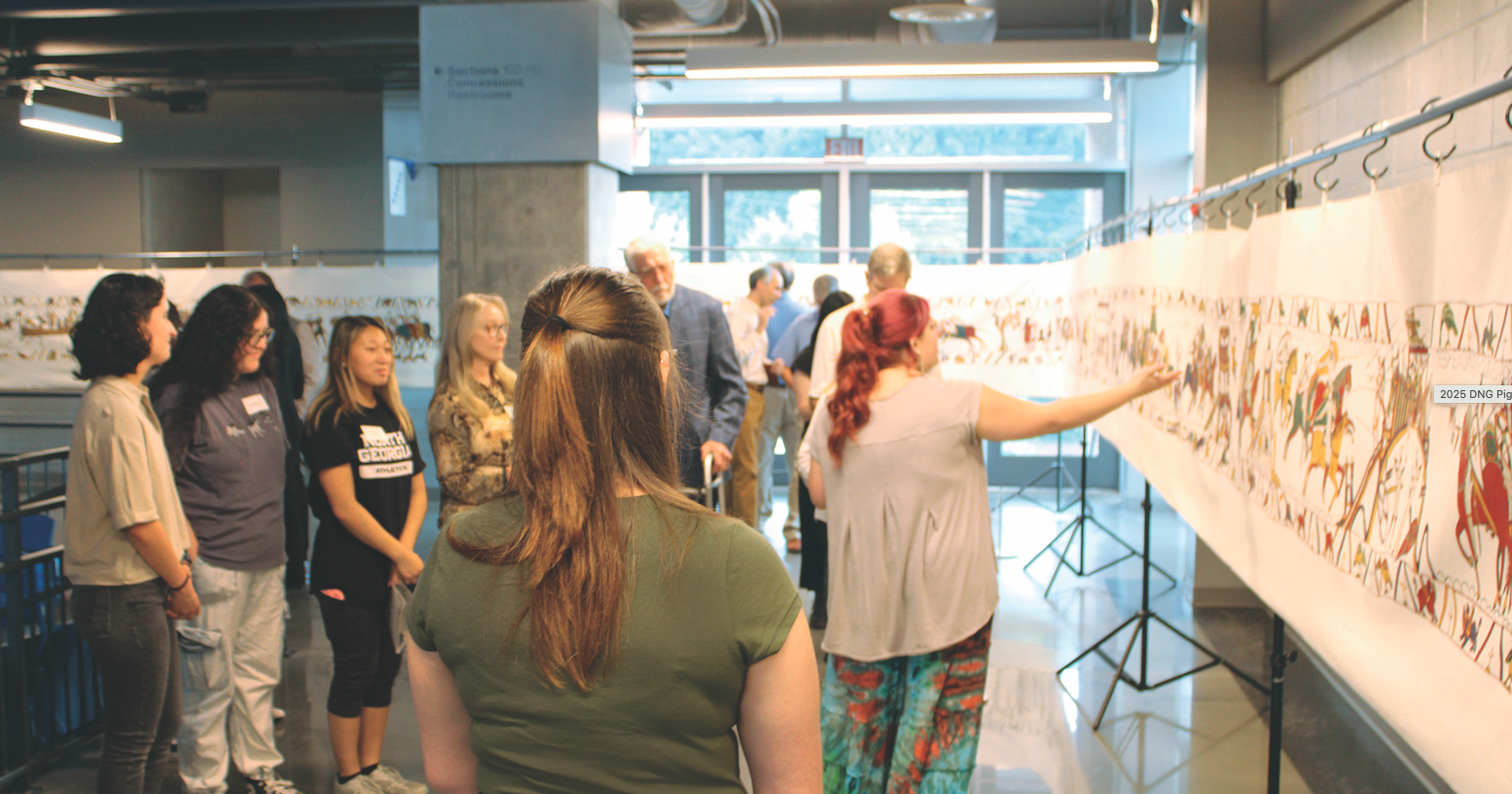
A series of staggered, student-led tours of the replica began promptly at 5 p.m. on the upper level of the UNG Convocation Center.
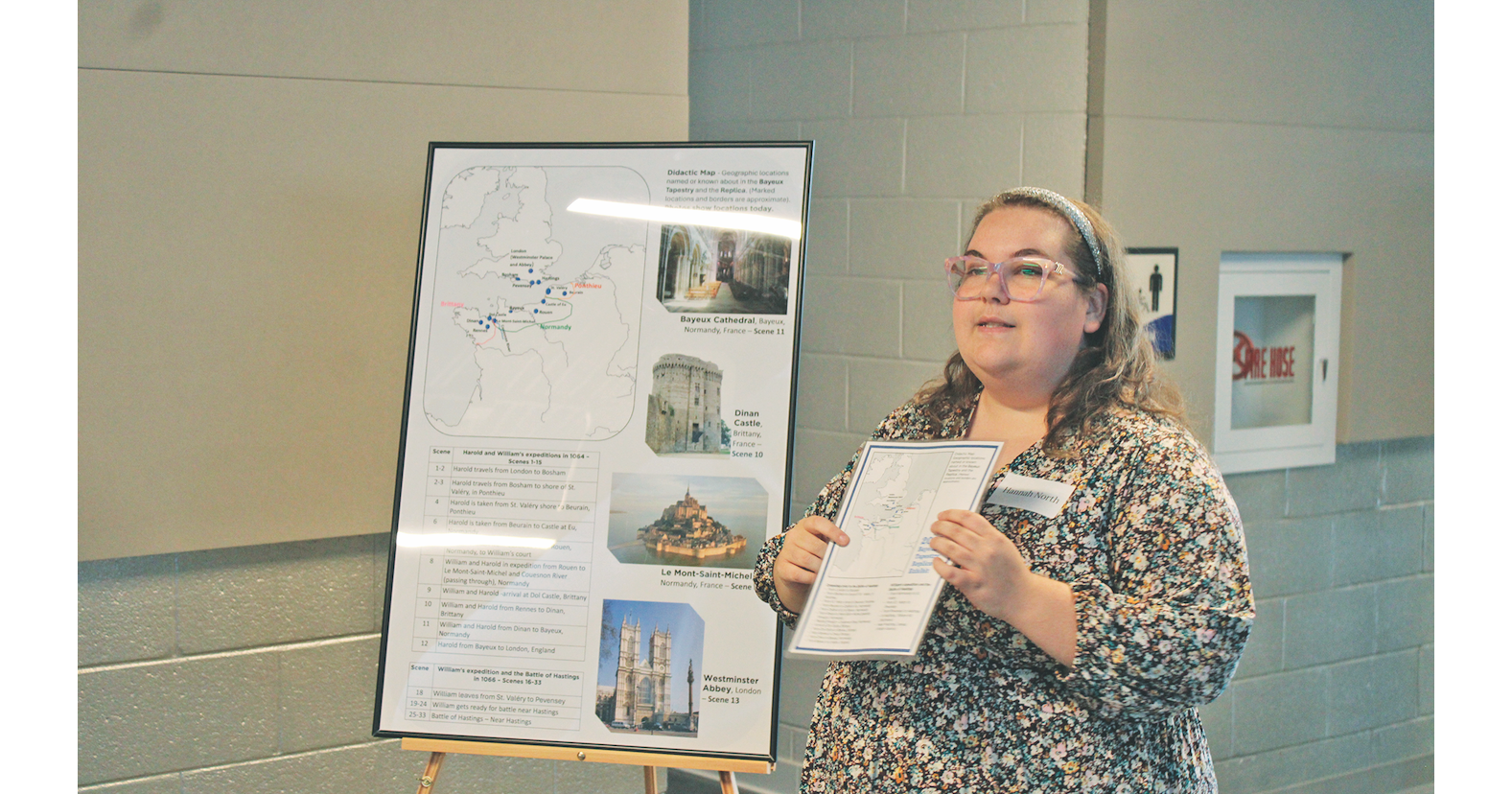
The first tour of the evening was hosted by UNG senior Hannah North, who is majoring in Studio Art with a minor in History.
“Come join me. It’s a fun story, at least,” North said at the start of her tour. “Historically accurate? I’ll let you be the judge of that.”
North introduced a few important historical figures who appear throughout the tapestry, including Edward the Confessor, Harold the Duke of Wessex, William the Duke of Normandy, and Odo the Bishop of Bayeux, who actually commissioned the original artwork.
North also showed the audience a map of real world locations that would be referenced in the tapestry.
“We’re going to go through some cool castles and sights like the Mont-Saint-Michel and Westminster Abbey ... Actually, Edward the Confessor built Westminster Abbey a week before his death,” she said.
North sounded a final note of caution for students of history, however.
“The tapestry is really cool and it’s a really lovely piece of art, [but] it was made by the French after they won, so I focus more on the artistic side of the tapestry and tell the story that the tapestry is telling. We all need to take everything they say with a grain of salt here,” she said.
King Edward’s appearance on the throne marks the beginning of the tapestry’s story.
North noted how Edward dwarfed all of the surrounding figures in size.
“He’s not a giant—this is just medieval art with hierarchical proportions: the bigger you are, the more important you are, and that’s why Edward is a giant,” she said, noting with a chuckle that if the king stood up inside the building as depicted “he would crash through the ceiling.”
The first scene depicts Edward addressing Harold.
“We believe he was telling Harold that he wants him to cross the English Channel and speak to Duke William of Normandy to tell him that when Edward dies, William will become king,” she said.
North noted that characters’ hair and clothing change frequently throughout the tapestry, making it difficult to track individuals as the story progresses.
She pointed out that the original artists used trees and tall buildings to break up space on the tapestry and help indicate a change of scene.
“This is kind of shorthand for … now we’re in a new place,” North said.
Another interesting feature of the tapestry is that while most of it reads left to right, like an English text, “some parts actually read better right to left.”
“Why? We’re not totally sure. Some people believe it was because as the tapestry was being embroidered somebody did it on the wrong side of the design and so this is actually backwards, or there could be another reason that’s just kind of been lost to time. Some people call it a ‘flashback,’ although flashbacks haven’t really hit the media yet,” North explained.
During the tour, a guest asked North about the horizontal bars running along the top and bottom of the tapestry containing smaller images of people, animals and plants.
“The marginalia is part of that old tradition with medieval illuminated manuscripts. Sometimes they’re related to the story. Sometimes, it’s just a cool bird,” North said.
INFORMATIVE INTRODUCTION
Dean of the College of Arts and Letters Dr. Elisabeth Burgess kicked off the reception portion of the evening by welcoming everyone to the university.
Next, Dr. Jespersen introduced the guest speaker for the evening.
“This is a real pleasure for me because I’ve known Andrew Leavitt for a long time,” Jespersen remarked.
He explained that Leavitt came to UNG from the University of West Georgia as a professor of Chemistry and assumed the role of Vice President for Advancement.
“[Leavitt] really helped bring the 21st century to Dahlonega. But more than that, he also brought some knowledge about a particular replica that was at West Georgia at the time,” Jespersen continued.
Apparently, Judge Wheeler was not particularly happy with the way West Georgia, the original custodian of the replica, was displaying it.
“In a sense, Andy Leavitt is the reason we have the tapestry replica at the University of North Georgia. It was his knowledge that the donor was unhappy with it, and it was his passion for it that led the rest of us to find out what this was all about,” Jespersen continued.
PASSIONATE PRESENTATION
“Thank you for that kind introduction,” Leavitt said after walking to the podium. “I’m just so happy to be back. I left UNG in 2014 to assume the Chancellorship at the University of Wisconsin, Oshkosh, and I just stepped down from that position June 30th.”
Leavitt said he wanted to explain why the tapestry replica is important to him personally. However, since he holds neither a degree in history nor art history, he said his presentation would range somewhere between “opinion” and “informed opinion.”
“This is not scholarship. This is fun that I’m after. If you leave here with the same infectious enthusiasm that I have for the tapestry, then I know I will have done my job. Facts? Those work too, I guess,” he continued.
He said his main qualifications to discuss the tapestry include having “chatty grandmothers” and an avid interest in his own family history.
Leavitt also personally witnessed the original tapestry on display at the Bayeux Cathedral in 2004.
“Bayeux, France, is right there on Normandy beach but was not touched during the invasion, which is quite remarkable. It’s still a very medieval town,” he said.
Leavitt encouraged everyone in the audience to visit the original tapestry if they are able.
“It is incredibly vibrant. It’s almost 1,000 years old and the colors really are quite amazing,” he said.
The original Bayeux Tapestry is thought to have been created in England a couple of years after the Battle of Hastings and was routinely taken out and displayed for holidays and other observances.
The tapestry was nearly lost during World War II, however, when the German army removed it from Bayeux and took it as far as Paris before being forced to withdraw from France and abandon their plunder.
In 1944, before it was returned to Bayeux, the French government displayed it at the Louvre Museum, the first time it had been displayed outside of its hometown.
Leavitt said now there are plans for the original tapestry to be moved again and temporarily displayed at the British Museum in England.
RELOCATED REPLICA
When Leavitt worked at West Georgia, the replica tapestry hung from an atrium in their Humanities building, but was very high off the ground and could only be viewed from the third or fourth floor.
Nonetheless, Leavitt said he never missed an opportunity to escort visiting faculty over to see the exhibit, even if they were fellow chemistry professors.
“I would drag that person over to the Humanities Building and show them that tapestry,” Leavitt said.
West Georgia was custodian of the display for 17 years, but after Leavitt transferred to North Georgia, Judge Wheeler contacted then-Representative Amos Amerson, who reached out and asked if UNG would be interested in housing the replica.
Leavitt connected Amerson with Jespersen, and the rest is history.
“My part in it was really just making that introduction, and it was really Chris and the story he told that kind of sealed the deal after that,” Leavitt explained.
In the final portion of his presentation, Leavitt reviewed his own genealogical background and why the people and places represented in the Bayeux tapestry resonate with his own family history.
“Making this available to others is a very, very powerful thing, and I hope that you continue to do that,” Leavitt told the UNG administrators in attendance.