
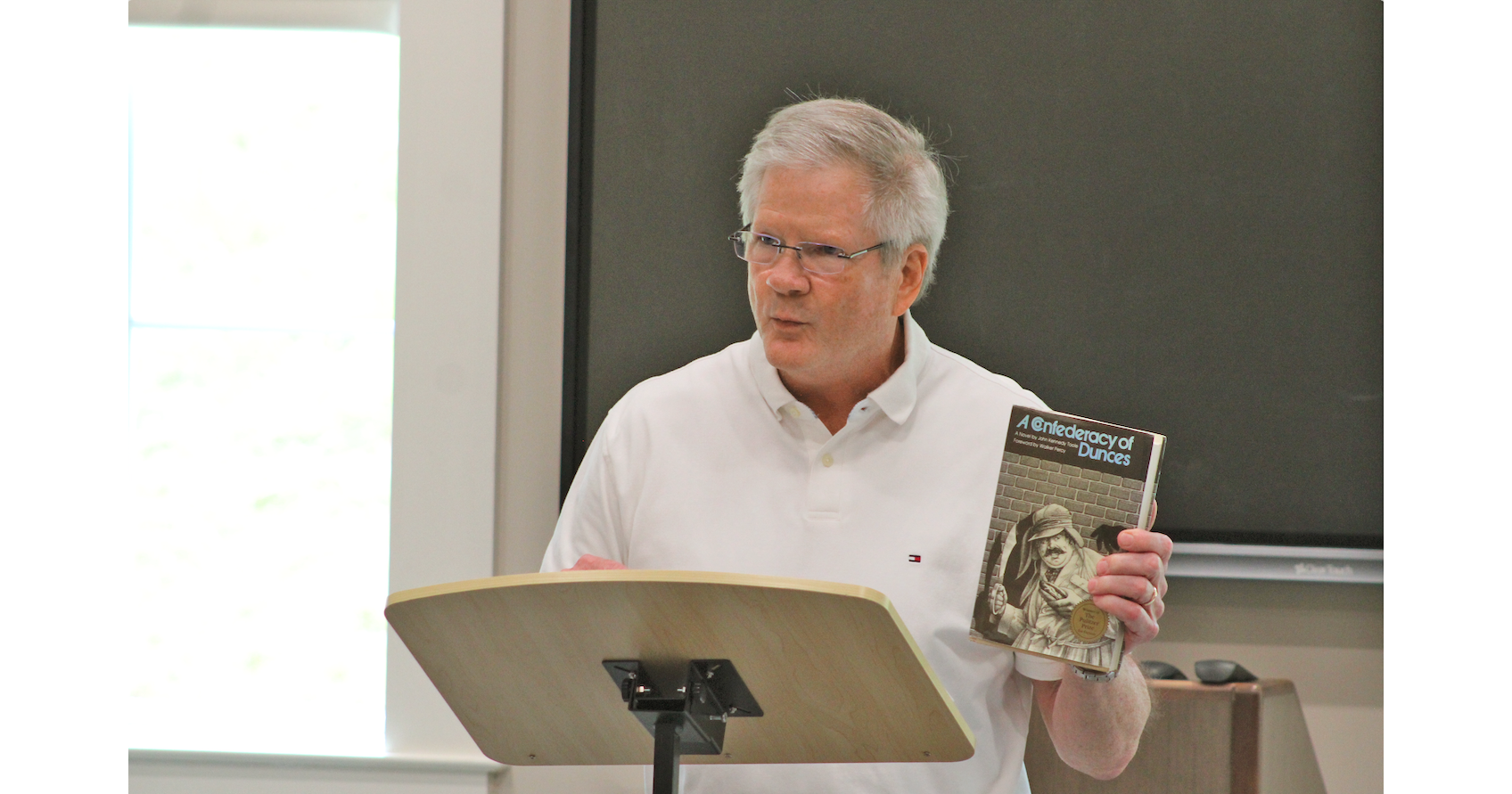
Luck was indeed a chicken for visitors to the local library for last month’s Authors in the Afternoon event. That’s because the July gathering, organized by the Lumpkin County Library Board, featured a discussion on humor in literature from none other than award-winning Georgia humor writer Jameson Gregg.
Gregg, a resident of north Georgia, won the coveted Georgia Author of the Year Award in 2015 for his debut comic fiction novel, Luck Be A Chicken.
His 2022 follow-up effort, Uncorked & Off The Chain: Offbeat Ramblings of a Zany Comic, won a national gold medal in the 2022 Independent Book Publishers Association [IBPA] Benjamin Franklin Awards.
PRESTIGIOUS PEDIGREE
Lumpkin County Library Branch Manager Agnes Gore was on hand to introduce Gregg, who kicked off his presentation with some jokes about technology.
“There’s certainly a generational divide when it comes to technology, but in my case it’s a multi-generational divide. This is a true story: my three-year-old granddaughter can turn on her tablet, open up her favorite apps and scroll around with her little fingers. When I was three, I was sitting in my backyard eating mud,” Gregg said to laughter from the audience.
After cracking a few more self-deprecating jokes, Gregg pivoted to the true purpose of his presentation.
“My talk today is about humor in literature. It’s not a traditional author talk, where the author talks about his or her writing journey and the inspirations that they have along the way and the interesting things that happened to them,” he began.
Gregg is from Mississippi originally, and attended Ole Miss as a business school student.
His summers consisted of a series of truly odd jobs that would inspire his later writing, including taxi driver, iceman at a chicken plant, a river tugboat deckhand and even a traveling circus promoter.
“I lived most of my life on St. Simons Island, Georgia. I had a successful 20-year law practice there in business and real estate. I achieved the highest national ranking for lawyers … a ranking that less than five percent of attorneys in the country achieve,” Gregg said before listing a litany of other accomplishments.
But Gregg said that even as a successful practicing lawyer, he experienced some inner turmoil.
“I had conflict in my belly. There was a seed planted in my stomach in undergraduate school to be a writer, and I always knew that I would be a writer. But I just couldn’t find the time when I was practicing law,” he recalled.
So Gregg did the unthinkable: he walked away from his profession at the height of his career in order to pursue his passion for writing.
“My wife, Maureen, and I moved to Dahlonega and got busy writing. We have since moved a few miles south across the County line, so we now have a Dawsonville address. But we still identify with Dahlonega,” he said.
Gregg’s first two books were massive hits, but his other humorous writings have also won awards and been featured in newspapers, magazines and anthologies.
“So, when asked to talk about the topic of humor in literature, I kind of took to it like a duck takes to water,” Gregg said.
THE BEST MEDICINE
Gregg said he intended to focus his remarks on the value of humor in literature.
“Satire’s ability to expose society’s collective flaws and beliefs improves the psyche of the reader,” he told the audience. “A little laughter, a little chuckle, a little smile while you’re reading a book is a marvelous thing.”
Gregg cited a recent Harvard Business Review article claiming adults in America are in the midst of a serious laughter drought.
“There’s plenty of stress and strife to go around, so I’m here to advocate and encourage humor as a stress-buster. When something makes us smile or laugh, those wonderful, feel-good endorphins are pumped through our systems; it’s nature’s anti-depressant,” he said.
Gregg pointed out that humans go from laughing an average of 400 times a day as a baby to only 15 times a day as an adult.
“Having fun is your biological heritage. But the problem is the daily hassle of our lives gradually erodes that heritage, and a gradual loss of our sense of humor is inevitable. We succumb to terminal seriousness,” he said.
Gregg’s solution? Try to inject a little more humor and laughter into your daily life.
“My goal is that perhaps you’ll learn about a book or an author that you haven’t read, seek it out and infuse a little bit of humor into your day.”
LEGACY OF LAUGHTER
Gregg started the discussion with two great comedic characters in literature.
“The best humorous fiction is built around strange, eccentric, crazy, high IQ characters,” he said before revealing the best-selling novel of all time, Don Quixote by Miguel de Cervantes, which has sold 500 million copies worldwide since it was published in two parts in 1605 and 1615.
“It’s a comedy, a farce, a parody. It’s got plenty of slapstick humor. It is satire writ large,” Gregg added.
Don Quixote has been translated into over 140 different languages, making it the most translated book after the Bible, and it satirizes the classic knight’s tale through the use of exaggerated characters and ludicrous scenarios.
“It did for the Spanish language what Shakespeare did for the English language,” Gregg pointed out.
The second character he chose to highlight was Ignatius J. Reilly from the book A Confederacy of Dunces by John Kennedy Toole.
“It won the Pulitzer Prize for fiction in 1981. It’s my favorite novel. It’s just hilarious, and the writing is over-the-top fabulous,” Gregg said.
He likens the character of Reilly to something of a modern-day Don Quixote: eccentric, idealistic and sometimes creative to the point of delusion.
WITTY WRITERS
Finally, Gregg chose to spotlight two famous humor authors starting with Benjamin Franklin, America’s first humorist and author of Poor Richard’s Almanac.
“Like the other yearly almanacs, it contained normal stuff like weather predictions, recipes and practical household hints. [Franklin] added humor to his almanac, and it shot to number one,” he said
Published from 1732-1758, Franklin’s almanac combined wisdom with humor, and philosophy with wordplay, to help shape America’s early culture.
“It was extremely popular. It made him a lot of money, and became an institution,” Gregg said.
The final author Gregg highlighted was none other than American author Mark Twain.
“It would be gross negligence for me to not include him in a talk like this,” Gregg said. “Even after all these years, he is still considered to be America’s greatest humorist, hands down.”
The author of classic novels The Adventures of Tom Sawyer and The Adventures of Huckleberry Finn, Twain delivered cynical, unabashed attacks on social hypocrisy.
“He had a masterful use of the language, and he was a masterful storyteller and weaver of tall tales,” Gregg praised.