
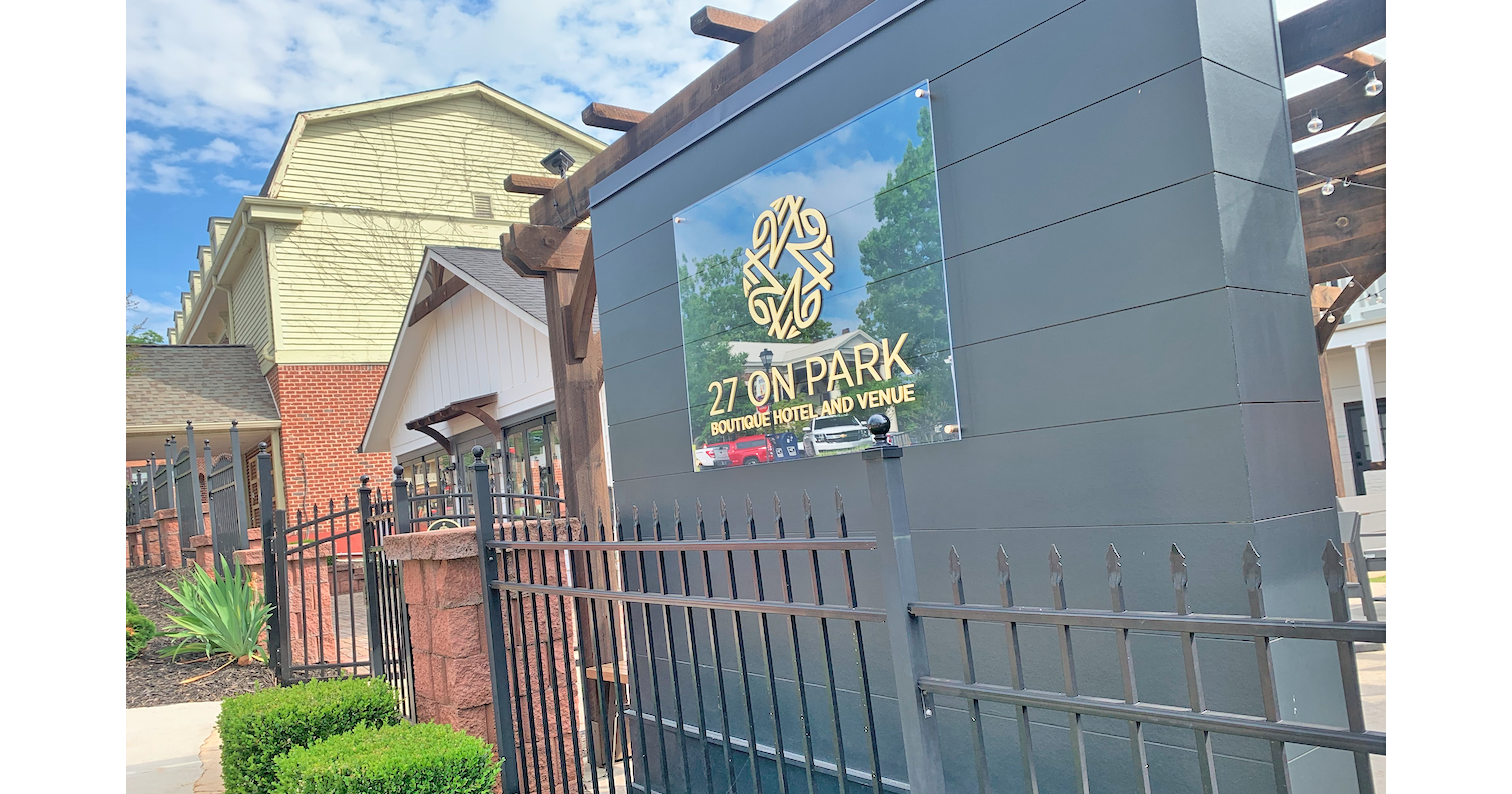
It all comes down to a matter of three feet and two inches for the owner of a recently renovated hotel in downtown Dahlonega. Last month, Dustin Kennedy was served notice that the sign in front of 27 on Park Boutique Hotel and Venue was too tall and out of compliance with City sign laws. In that notice he was informed that he had three days to remove the sign and, if not, face some hefty daily fines.
“Please note that any violation of this ordinance is considered a misdemeanor and may result in a fine of up to $1,000 for each violation,” stated the notice from city code enforcement officer Tim Martin. “It is important to note that every day that the illegal sign remains beyond the period to correct the illegality shall be considered a separate violation.”
With that in mind, the new local business owner stood before the members of the City Council last Monday as he asked for a variance and explained the unusual circumstances which led to his eight foot tall sign on the edge of his newly acquired South Park Street property.
“In January we hired Signarama, which is a large sign company out of Buford, Georgia,” he said from the podium with his wife Michelle by his side. “… We hired them to do A to Z. We got A to B and skipped to the end.”
The crucial step that was skipped was the acquisition of an actual sign permit.
Records show Kennedy paid the company just over $1,300 to create and install the sign on an eight foot barrier wall on the edge of the hotel property. It wasn’t until after the sign was finished and attached to the wall that he was informed by City officials that he was permit-less. Kennedy then applied for a permit but was later informed that his sign was three feet and two inches too tall.
“Signs may not exceed a height of five feet at the highest point anywhere on the sign,” stated the City permit denial.
Martin’s notice of possible $1,000 fines followed on May 3. As a result, Kennedy filed an appeal which put a halt on any possible daily fines until the council, acting as the Zoning Board of Appeals, can rule one way or the other.
PROPERTY PROBLEM
During last week’s hearing, Kennedy said he was making use of the peculiar layout and topography of the property, which already included a barrier wall when he got there.
He also sought to convey that his options are limited for sign placement since he’s required to have a fence around the property for insurance reasons, which blocks a large section of the wall.
“This only left 47 inches of visible height to mount a sign above the height above the fence,” he said. “… It does present kind of a unique situation for us.”
Kennedy added that the barrier wall, which contained the sign, was initially covered in faux greenery prior to their recent refurbishment of the property.
“Our intention was to increase the attractiveness of a structure that was previously there by converting it to a focal point because it is the center of our property,” he said. “It was also aesthetically pleasing to do that as well.”
Kennedy added that the sign has helped clear up constant confusion about what kind of business actually resides on the property, which is located in the bustling area right next to the Dahlonega Visitor’s Center.
“Before the sign was in place, visitors would frequently, like several times a week, walk by the property, walk into our office and inquire what type of property this was,” he said. “We got everything from apartments to restaurants to event space. Nobody knew what it was. Even though we had a sign at the top of the property.”
‘THE CURE IS WORSE’
Members of the council agreed that the property looks much better than it did before. And council member Johnny Ariemma said the removal of the sign, which would just result in a plain black wall, wouldn’t be much of an improvement.
“I think the cure is worse than what we got right now,” he said. “Because what we got right now is very appealing. I don’t want to bastardize our ordinances that we’ve got in place but I think it’s a very unique situation. It’s a very unique property.”
Council member Lance Bagley seemed to agree.
“There really is no excuse not to have a permit. It is a requirement,” he said. “… Having said that, the green Astroturf [on the wall before] was not a good look for the city. What you all have done, as you’ve done with other parts of your hotel, it looks professional. It looks classy. It looks a lot better than what was there before. … Again we do have ordinances. What we’re struggling with is making sure people are following that.”
Martin was called to the podium and agreed with other council members that Kennedy was a victim of the original owner’s tendency to pay fines first and get permitting later. But he added that it’s all about precedent when it comes to code enforcement.
“We’re going to set a precedent for everybody else that they’re going to be able to have an eight foot, ten foot, structure,” said Martin.
Council member Ryan Reagin said he sympathized with both sides.
“I think Tim is one of the great City of Dahlonega employees,” he said. “He’s sort of in a bind here. You’re in a bind here. It’s just a bad situation. It was a green leafy sign. I don’t know how that would have been approved. … This looks, in my opinion, better.”
Mayor JoAnne Taylor concluded the discussion by urging the council to think about future variance requests when making a decision.
“I think one of the questions that you, as council, have to assess is ‘What about the next time somebody wants a 98-inch sign in the Historic District?’” she said. “I get all the arguments on how it looks better. I don’t disagree with that. But it’s a question of ‘What do we do the next time?’ So that’s the topic before you.”
The council will ultimately vote on whether to approve or deny the appeal at an upcoming session.
Though the item hasn’t been placed on the agenda, City Attorney Doug Parks suggested the vote could take place at the July 8 meeting.