
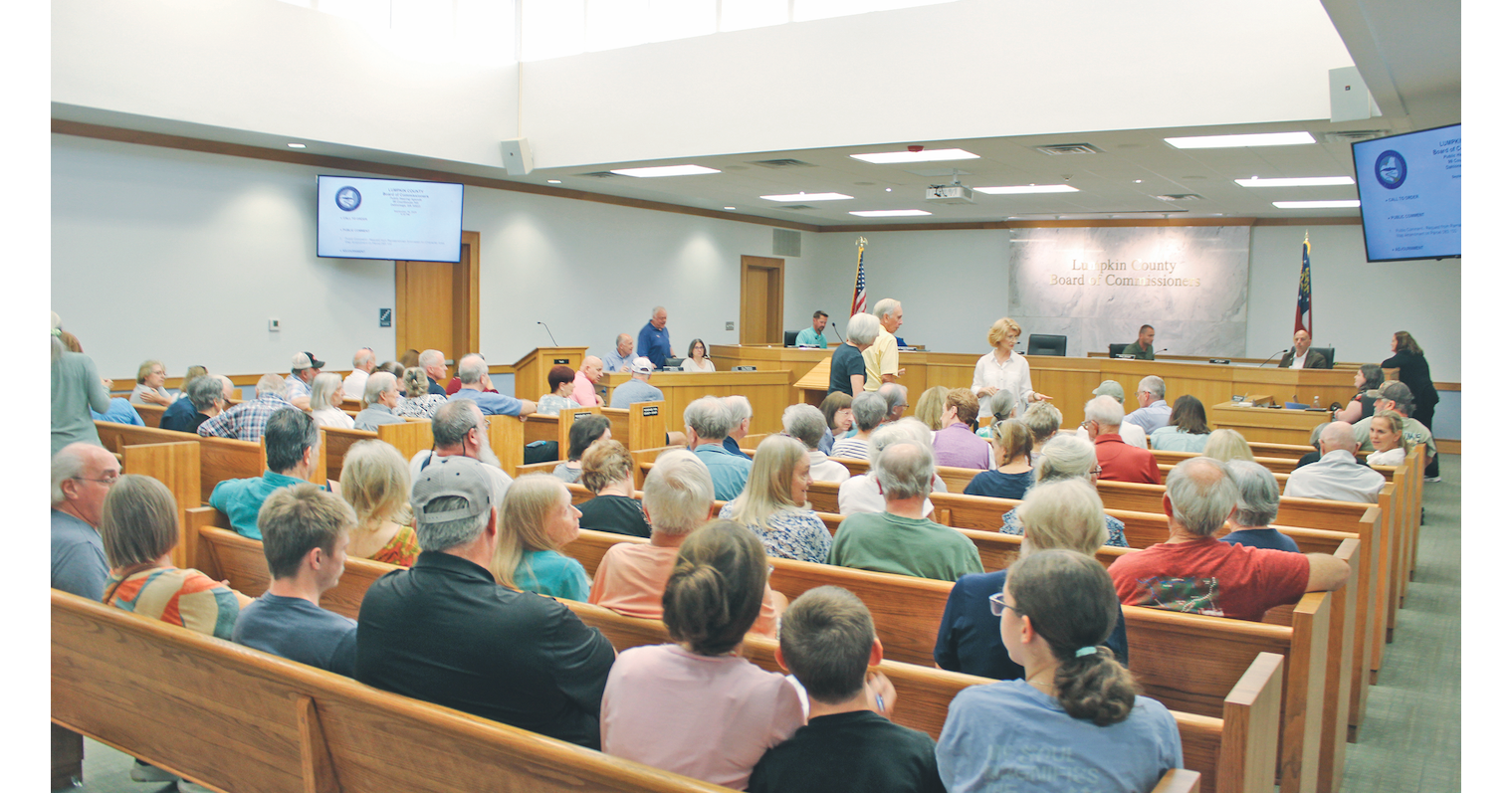
Does the recent influx of large-scale residential proposals in Lumpkin represent one final burst of housing expansion on the 400 corridor, as residential sewer capacity limits kick in? Will anticipated GDOT improvements at the end of GA 400 be completed in time to handle additional vehicle traffic in the already-congested area? These and many more growth-related questions were on the table last week as a standing-room-only crowd of concerned residents turned out for a contentious hearing of the Board of Commissioners.
Ultimately, the board chose to table a developer’s request for a Character Area Map [CAM] amendment for a 49.17 acre parcel located off of Brandy Mountain Rd., near the busy intersection of Hwy. 60 and GA 400, for one month.
As previously reported in The Nugget, the County Planning Commission had voted to recommend approval of the CAM amendment during their meeting earlier this month.
Community Development Director Vanessa McGrath explained at the meeting’s outset that the proposed amendment would effectively re-authorize an expired CAM amendment from September of 2022, returning the property from Residential Growth back to Gateway Corridor Overlay District at the developer’s urging.
The change would allow for increased density over the current zoning, although the overall scope of the development has decreased from 288 multi-story units to 150 single-story units.
PROJECT HISTORY
McGrath indicated that the developer, Ramakrishnan Srinivasan with United Family Homes, is requesting to return the property to a Gateway Corridor Overlay District now that he has obtained approval for a commercial entrance off of Hwy. 60 from the Georgia Department of Transportation [GDOT].
McGrath said of the 49.47 total acres, approximately 24 acres are to be disturbed next to Hwy. 60, on the north of the property.
“They have already paid portions of the water and sewage taps to the Water & Sewer board, and that would be rolled over. They will re-apply to the Planning Commission, potentially [at] the November meeting, for a multi-family development with an amended site plan,” she explained, adding that the applicant had submitted all required application materials.
Vice Chair Rhett Stringer presided over the hearing in the absence of Chairman Chris Dockery, who was attending an Association of County Commissioners of Georgia [ACCG] meeting.
Stringer said that two other projects have been given letters saying the new plant has capacity for their projects by the Water Authority board.
He noted that a different developer also has had to reduce their sewer allotment request based on restrictions contained in the allocation ordinance.
Stringer informed the large crowd that the usual guidelines limiting each side to 15 minutes would be waived, so that everyone would have an opportunity to speak.
The applicant spoke first on behalf of the request.
Srinivasan indicated that he too had to reduce the original size of his project in order to gain sewer access.
“We got our approval with GDOT online, and we just got our sewer permission and everything, so now we are bringing it to you,” he told the board.
WEIGHING IN
The only citizen to speak in support of the project, as he did at the Planning Commission meeting, was Sean Phipps—the Lumpkin County Water & Sewerage Authority Director.
“I can tell we have a very interested crowd tonight. A lot of people are here, and this is a different audience than we had when this project was previously approved a couple of years ago,” Phipps began before delving into the history of the development.
He said when the applicant originally approached his department in 2022, there was not enough sewer capacity available at the current Red Oak Flats treatment plant.
“We advised them if they could refrain or hold back on their schedule until the point in time when the [new] sewer plant was available, then we would have capacity to serve it. So they proceeded with applying for permission to approve that element, and that was actually approved in 2024 for a much more intensive land use,” Phipps said.
He said despite subsequent permitting issues, the developers have “made an effort and have been working toward getting this completed during that timeframe.”
He noted that the developer has “already paid the Water & Sewerage Authority sewer and water tap fees for a portion of what’s due for the project. That payment is around $376,000. There is quite a bit more tap fees that would be collected by the Water Authority if the project moves forward.”
Phipps urged the board to approve the CAM amendment a second time—“to go ahead and stand pat with what they did previously and allow this to move forward.”
ORGANIZED OPPOSITION
With no one else speaking in favor, the meeting was recessed for five minutes so the opposition could organize their thoughts.
Robert Harrier was first to take to the podium.
“First and foremost, it sounds like you guys already are okay with this project. I’d like a show of hands from the Board who will be voting for this,” he asked, but the commissioners declined the invitation.
“We will be voting at the 6 o’clock meeting,” Commissioner Tucker Greene responded.
Harrier, whose wife works at the new hospital, highlighted the congestion at the end of GA 400.
“She got off work last night and couldn’t get home. [She] had to go all the way down to Dawsonville and go down to Price Road and come the back way through Murrayville just to get home, because of one wreck. Now you want to bring all these homes in here, which is more people. And the way it sounds, it’s going to be another 500 to 1,000 vehicles on 400. When is enough going to be enough? Why are you not working for the people of this County instead of working for millionaires? Are you guys getting your pockets lined here, or what’s going on?” he asked pointedly.
Harrier said emergency vehicles could have a difficult time getting into and out of the hospital in the future.
“More people equals more crime, more cars and more wrecks,” he said before pivoting to face the audience.
“Any of these people that vote for this project, come next election cycle, we boot their butts out,” he implored. “I’m tired of it,” he added as the crowd applauded wildly.
Next in opposition was River Knoll resident Ken Corbin, who brought a PowerPoint presentation to assist him.
Earlier this month Corbin said he requested current traffic counts on Hwy. 60 and GA 400 from the County, as well as data from five years ago, but was referred to GDOT by Dockery.
And while he was aware of GDOT plans to add a new right-hand turning lane at the end of GA 400, he said Dockery told him via email that a widening of Hwy. 60 between GA 400 and Morrison Moore Parkway is not in the cards.
Corbin tallied a list of potential residential projects coming to both the County and the City of Dahlonega, and estimated that they would add over 4,000 vehicles to local roads, assuming two vehicles per unit and two trips per day.
Corbin proposed a threefold solution, all contingent on improvements to the three major thoroughfares: Hwy. 60, GA 400 and Morrison Moore Parkway.
He called for an immediate moratorium on approval of any new multi-family developments in the County. He also said the University of North Georgia should pause further expansion of the Dahlonega campus and prohibit freshmen students from having a vehicle.
Former Planning Commission member Steve Sylvester argued that a lot has changed in the three years since the first CAM amendment was granted.
“This development may have made sense back then, but it doesn’t anymore at this dangerous intersection,” he said.
“This property was designated Restricted Development, which severely restricts multi-family developments. Commissioners, you have the opportunity to keep this property’s Restricted Development designation, which will keep the housing density at one house per acre, instead of the proposed high development four to five homes per acre. Now is the time to stick to our plan,” Sylvester urged the board.
“There are other developers waiting on the sewage capacity tied up by United Family that are not requesting us to abandon our zoning designations,” he argued.
A total of 13 citizens spoke out against the amendment, including two local political candidates, City Council candidate Tom Gordineer and County Chair candidate Katherine James.
REGULAR MEETING
When the item came up for a vote at the regular session later that evening, many of the attendees for the public hearing had already filed out of the room.
Commissioner Dr. Bobby Mayfield made a motion to table the CAM amendment until next month, and Greene seconded.
Stringer called for a vote, but Mayfield said he wanted to discuss further.
“The reason I made a motion to table it is because of the input that we received, and that was a huge volume of input. I think it’s going to take a little time for us to digest and process that—to reflect on it. I wouldn’t want to do anything hasty. It might not be a good decision, and we’ve already been bitten by that before,” Mayfield said.
After the unanimous vote to table, Greene said he disagreed with some online comments “over the last 24 hours” suggesting that the board would not care about the public’s input on the issue.
“We were elected by you to represent you, the 35,000 people in Lumpkin County. And so I appreciate you guys showing up this evening. It doesn’t mean we’re going to sway one way or the other, we just felt after hearing the comments and the points that were made tonight that we needed to give this matter more time,” Greene concluded before thanking the crowd.
Mayfield called on the public to remain calm, especially given the current political climate.
“We are here to listen. That’s why we’re sitting here,” he assured the audience.