
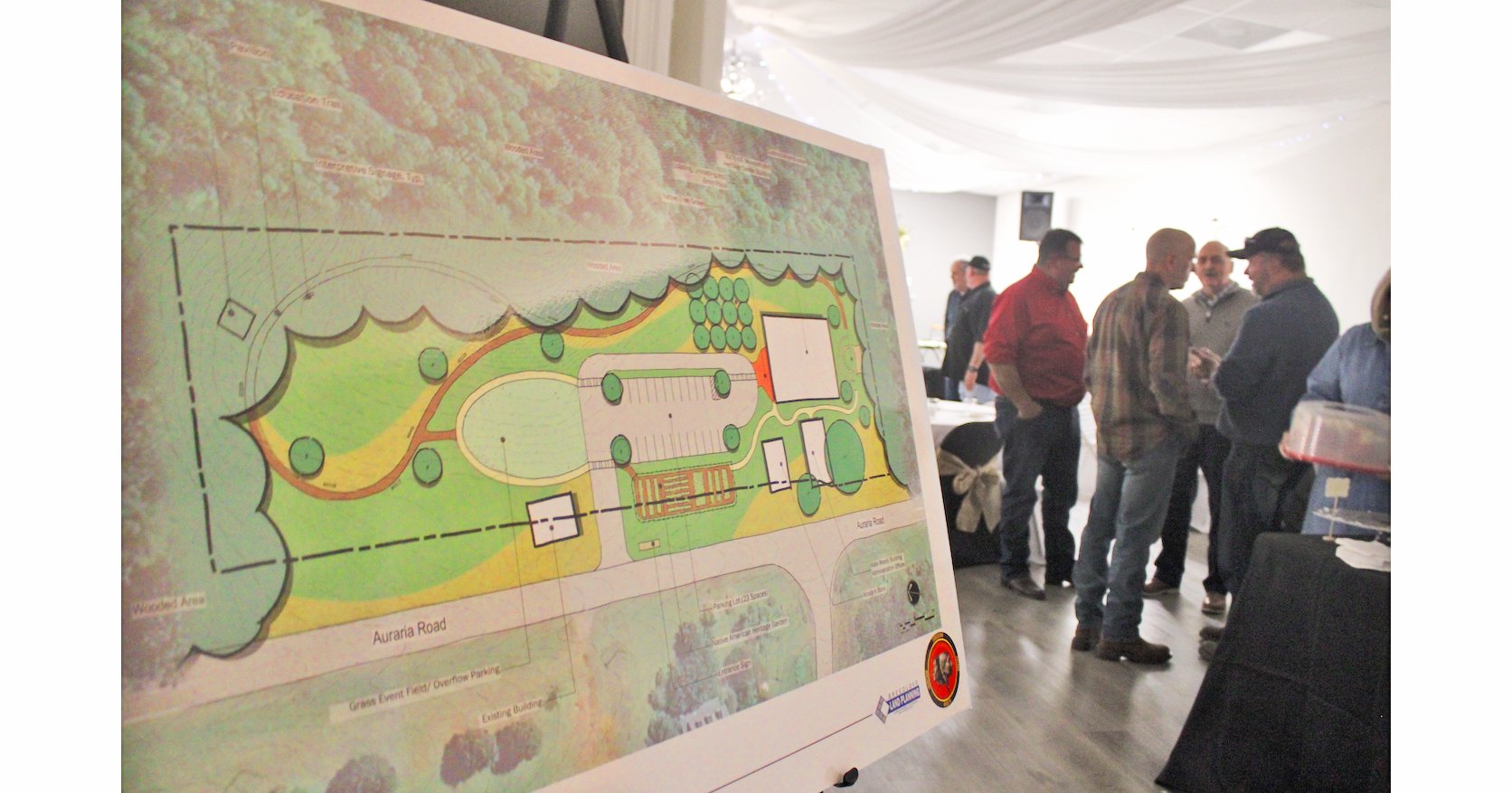
A plan that would see Woody’s General Store and the surrounding Auraria property transformed into a museum and heritage center honoring the Georgia Tribe of the Eastern Cherokee is gaining fresh momentum. At the Tribe’s latest meeting Saturday night, Council Chair Rhonda Bennett and her husband Jim unveiled the first concept designs for the highly-anticipated project.
The idea also gained further traction when it received a number of public endorsements at the meeting, including from County Chairman Chris Dockery.
Dockery even announced two new votes that the Board of Commissioners would undertake to raise the local profile of both the museum project and the Tribe itself.
PURPOSEFUL PARTY
“Thank you for coming out to the Venue at 223. We’re just glad everybody showed up for a worthwhile purpose and reason,” Jim said at the start of the event, which included live music and a barbecue dinner.
He pointed out former Lumpkin County Sole Commissioner and Tribe member J.B. Jones, who was seated in the audience.
“We’ve got J.B. Jones here tonight, and I hear it’s his birthday,” Jim announced as the band played and the crowd sang “Happy Birthday.”
Jim thanked everyone for coming out and being involved in the museum project.
“This is a story that has needed to be told for years and years and years, and I think it’s finally coming to the forefront,” he said before inviting Rev. Ricky Woody up to bless the meal.
After saying grace, Woody also spoke a little about the museum.
“I’m here because the property out there belonged to my mother and my father. They bought it in 1958,” he began.
“We’ve got an opportunity here to be a part of something amazing and something wonderful,” Woody continued. “I’m thankful, and I know my mom and dad are thankful, that something is being done with that property there.”
He asked those who can to contribute money or labor toward the effort.
“If everybody gives a little, it will turn into a lot. The Lord tells us that many hands make light work, and when this thing is done, it’s going to take volunteers to run it,” Woody said.
“Thank you, Ricky,” Jim said before introducing his wife.
NATIVE NARRATIVE
Rhonda recounted some of the Tribe’s history and explained why both the museum and potential federal recognition are crucial to preserving that legacy.
“This project is so important, not only to our Tribe, but to this community,” she said. “The Cherokee were here a long time before the white people came.”
She explained how the Cherokee started out with more than 22 million acres, but by the time the Trail of Tears took place 85 percent of the Cherokee population was concentrated in north Georgia.
“Most of the population settled in the river areas. They lived in towns and villages. By the time the 1830s came around it was a different world for the Cherokee. It was kind of like a renaissance era for them. They completely changed their way of life. The average Cherokee person had about 14 acres of land and a log cabin in this area,” Rhonda continued.
She attributed part of that success to the Cherokee syllabary, or alphabet system, crated by Sequoyah over a 12 year period in the late 1810s and early 1820s.
“It enabled the Cherokee to become educated. They were able to start a legal system, a nation, a capital—they were able to become more civilized,” Rhonda said.
“They saw how the whites lived, and they were tired of fighting … They decided to start working in the white man’s culture. His laws and way of life were entrenched in the Cherokee. They realized the livelihood of their nation was actually going to depend on them having their own government, their own constitution and being able to live with the whites. And they did all of that,” she added.
There were many mixed blood Cherokee, and some of them were wealthy traders and mill owners. But the federal government would ultimately turn against the successful tribe.
“The Cherokee made treaties with the federal government, so that land should have been theirs forever. However, forever was only until the gold was found in Auraria,” Rhonda said.
Laws were passed in Georgia dictating that the Cherokee could no longer have their own nation, even though the Supreme Court voted in favor of the Native Americans. Andrew Jackson, the President at the time, said he supported Georgia, not the Cherokee people.
The resulting laws that were passed from 1827 to 1831 effectively abolished the Cherokee nation.
All the Cherokee’s property was given away in 160-acre lots through the land lottery and 40-acre lots through the gold lottery. Even their homes and other goods were subject to confiscation.
The Cherokee could not testify in court against a white man, effectively negating their private property rights. They also couldn’t go to school or own land.
“They weren’t supposed to exist. But there were so many mixed blood Cherokee who identified as Cherokee, because the Cherokee is a matrilineal society. The heritage comes through the mother’s bloodline, so it wouldn’t really matter if a mother married into a European or white family, the children were still considered Cherokee,” Rhonda explained.
She said Cherokee families like hers and Jones’ simply “want to be recognized, and not necessarily for any reason other than we’re here, and we exist.”
“All the Cherokee are not living in Oklahoma. They live here, as well. This was the home of the Cherokee at the time of the removal. North Carolina was a part of the Cherokee nation, but they have a problem recognizing us, too,” she said, adding that it was a sad situation.
Rhonda said she is surprised something hasn’t been built in Dahlonega to honor the Cherokee history before now.
“If nothing ever comes of recognition or anything else, I think this museum and heritage center is a tribute to who was here and what happened here in this community,” she said.
She believes the educational center will become a tourism destination.
“Inside the museum, we want to have a portion that’s called our heritage center. We want to have people come in and talk about their stories and memories they have of what their grandmothers may have told them … We want to learn our ceremonies, we want to learn our language again. We want to bring some of this stuff back to Georgia,” she said.
COMMUNITY PARTNERS
Rhonda acknowledged some community partners helping with the project, including UNG Special Collections & Digital Initiatives Librarian Allison Galloup.
“The University of North Georgia is actually working with us to digitize our records. We’re going to have kind of like a library of our Tribe that anyone can access if they come through a Tribal member,” Rhonda explained before welcoming Galloup, who said the college is about a quarter of the way through the digitization process after about a year.
“The collection is about 16 linear feet. If you think of the fold out banker’s storage boxes, it is roughly 16 of those and growing, because you guys are still meeting and still communicating with each other, so the collection will continue to grow,” Galloup noted.
Next to speak was Lumpkin County Historical Society President Janet Barger.
“When Rhonda approached us and told us she was doing this, we were absolutely delighted … We fully support not only the preservation of Auraria, but also telling the story of what went on there,” Barger said.
Boy Scouts of America Lodge Advisor Rusty Royston also spoke about a new partnership between the Order of the Arrow and the Georgia Tribe of Eastern Cherokee.
“This past June we signed a formal memorandum of understanding between the Georgia Tribe of Eastern Cherokee and the Northeast Georgia Council of the Boy Scouts of America, agreeing to support each other’s purpose, activities and related initiatives,” Royston explained.
He said the museum will be a site for robust outdoor programming on the Cherokee relationship to the land.
“We support with great enthusiasm the development of the heritage center, and we look forward to being a strong partner in making this a reality,” Royston added.
Dockery also went on the record with brand new commitments from the County.
“I’m going to take to my board, and I don’t think I’ll have a problem getting their support, a resolution that recognizes the Georgia Tribe of the Eastern Cherokee. I don’t think that’s ever been done, and I think you need that for your case. I’m also going to take to the board a resolution that will name Auraria Road from the intersection of Hwy. 52 to the County line as the Cherokee Heritage Parkway,” Dockery said to thunderous applause.
“Keep up the momentum, and I can promise you we’re going to be with you as a County,” he told the Tribe.
CLOSING COMMENTS
“That was a wonderful surprise,” Rhonda said following Dockery’s announcements.
She thanked property owner Floyd Wimpy for working with the Tribe to obtain the land for the museum.
“I made a deal with Rhonda,” Wimpy told the audience. “If they get it, they can never sell it. And I hope that will be held. It will be here from now on, and everyone will remember it,” he said of the museum.
“It’s been a long time coming, and I know Ms. Woody would have really wanted it.”
Jim closed out the meeting with an appeal for fundraising, which will begin soon.
"If you’d like to make donations they’re a 501(c)3,” he said before closing the meeting.
“That property is a wonderful, wonderful location and I see this thing just blossoming,” he said of the museum project.
For more information or to donate to the museum, please visit www.georgiacherokeetribe.com.